Markets in motion: A beginner’s guide to market moves
Market headlines can feel contradictory: rallies during downturns, dips during longer-term rises. Here’s a plain-English guide to trends, volatility and market narratives, and what investors usually mean by terms like correction, drawdown, bull market and bear market.
Authors:
Navisha Joshi | Andrew Lacey
Last updated: 17 November 2026
At a glance:
- Markets move constantly, and short-term dips are normal and not usually a sign something has gone wrong.
- Most market updates focus on three things: trend (direction), volatility (how bumpy it is), and narrative plus sentiment (the story and mood).
- Markets can seem to defy headlines because they react to expectations and surprises, not just whether news sounds positive or negative.
- Bull and bear markets are shorthand labels for periods when markets have been rising or falling for a while, often with investors feeling more optimistic or more cautious.
- Learning the shared language helps you keep perspective, so you can tell normal day-to-day noise from changes that may deserve a closer look.
Introduction
Financial markets move around – both up and down – all the time. Most investors participate in markets with the expectation that over the long-term, the value of their portfolio will rise. And for most investors with a long-term investment horizon and a balanced, diversified portfolio, this is justified. Historically, broadly diversified portfolios have tended to increase in value over long periods (although not guaranteed; portfolios can decline, sometimes for extended periods).
In the short-term though, it is not uncommon for portfolios to experience periods of weaker performance. These periods can be days, weeks, months and sometimes longer. Bouts of weakness are not usually a sign that something has 'gone wrong'.
For most portfolios, performance is heavily influenced by what’s happening in financial markets. Exactly how a portfolio performs will, of course, depend on the the investments it holds. But almost all portfolios are affected by market moves, which rarely move smoothly, and this can be unsettling.
Here we introduce the language that professional investors use to describe market movements, which generally captures:
- Market reactions: How markets are responding (or have responded) to new information, new events or any changes to ongoing scenarios, particularly over shorter periods of time.
- Market trends: Broader trends in market direction tend to be the result of big stories that affect a large number of people and companies. Details of these stories can change from day-to-day (sometimes more frequently). Often market reactions are the result of investors deciding if the new details change a bigger story.
The aim is to help you build a clearer understanding of market movements, to help you decide when a market move is ‘normal noise’ or requires action.
By the end, readers should be able to:
- understand common labels such as corrections, trends, volatility, bull and bear markets, and what they usually refer to,
- recognise why markets can look ‘contradictory’ at times, such as rallies during downturns or pullbacks during longer-term rises,
- feel more confident in reading market commentary without assuming that every single market move needs action.
What does it mean when ‘markets move’?
'Market movements' usually refer to the price changes in a broad market index (rather than individual shares or funds). In practice, they can also refer to moves in a sector, an asset class (like bonds), or a single investment – it depends on the context.
Most market commentary will explain or form a narrative to describe market moves, with different qualifiers depending on timeframe (day, month, year), the market or asset in focus, and whether the movement is in step with – or counter to – a bigger underlying story.
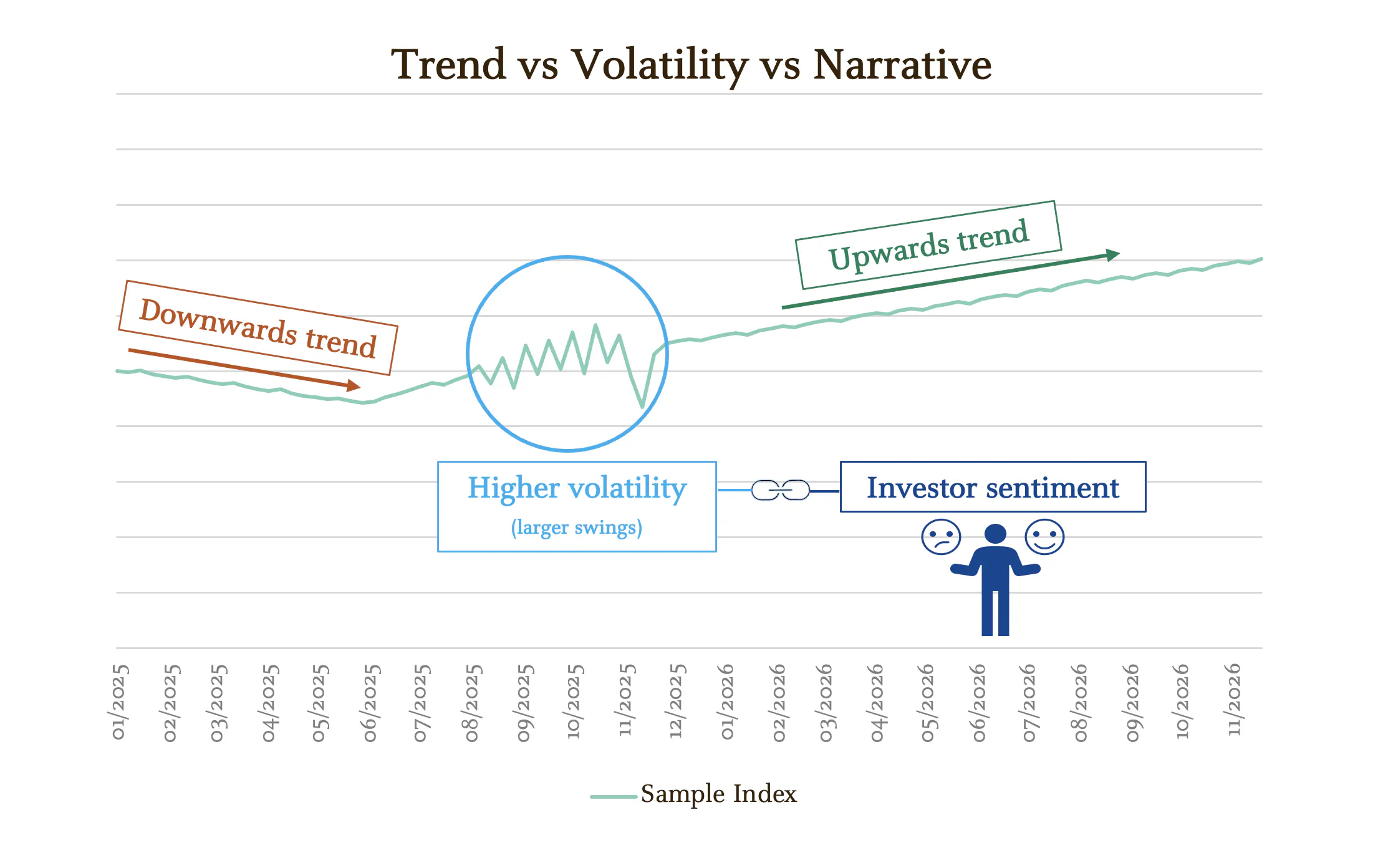
Market commentary often circles around three common ideas: trends, volatility, and a combination of narrative and sentiment.
Trend: the direction
A trend describes the broad direction in which markets, asset prices or consumer behaviour have been moving over a period of time. It can also refer to economic data points that, in aggregate, point towards an overarching trend that might support (or weigh on) markets and economic activity.
The key detail is the timeframe, but the size of the move also matters. For a market rising for five years, a three-month period of weakness in the middle does not upset the directional trend. A small dip during a multi-year rise might just be normal ups and downs. However, a big, sudden fall over a short period can be seen as a break in the trend, even if the longer-term performance is still positive.
Directionally, trends will typically fall into one of the below:
- Upward trend ('bullish'): prices and/or demand have experienced a sustained upward bias for a period of time, creating a pattern of higher highs and higher lows.
- Downward trend ('bearish'): prices and/or demand have experienced a sustained period of decline, creating a pattern of weakening (for example, in markets or economic data). Highs do not reach previous highs, and lows are generally lower than preceding lows.
- Sideways (also ‘neutral’, or sometimes ‘range bound’): prices and/or demand move within a flat range, with no clear upwards or downwards push. Usually, this is the result of positive market events meeting less positive (or negative) stories, with neither prevailing to dictate market direction.
Volatility: choppiness of the journey
Volatility broadly describes the size and speed of market swings. It shows how ‘smooth’ or ‘bumpy’ the ride is, and not whether the market goes up or down. Volatility is not the same as investment risk.
Broadly speaking, volatility represents how much prices move around. It’s important because volatility can play a role in an investor missing an investment goal, possibly because they felt it necessary to sell at the wrong time.
A volatile week might look dramatic on a one-month chart but barely show up on a five-year chart. That difference in timeframe is one reason market commentary can feel confusing.
Volatility can often be higher when uncertainty is higher. Sometimes this is linked to big news or events; other times it can simply occur because investors disagree more strongly about what may happen next.
You can learn more on how to handle market volatility in our linked guide.
Narrative and sentiment: how investors feel, and why
A narrative is the story that investors attach to market moves, such as:
- Earnings reports – Markets can be moved by the overall strength or weakness in expectations surrounding earnings growth. Listed companies are typically required to report earnings at regular intervals, allowing investors to assess profitability now against longer-term trends.
- Interest rate expectations – Interest rates are an important tool that many central banks use to maintain economic stability and price. Central bank decisions to raise or lower interest rates can have major implications for financial markets, so are closely watched.
- Geopolitical developments – Major geopolitical events like the outbreak of war can, in addition to the human toll, be enormously disruptive for vital global supply chains. The complexity of some supply chains means the full implications of certain geopolitical events can take time to fully understand, creating lasting uncertainty.
Narratives (the ‘story' investors tell about what’s happening) can help explain market moves, but they can change quickly and multiple narratives can compete at the same time.
Closely linked to narratives, sentiment is the overall mood of investors: optimistic, cautious, or fearful. Sentiment can swing faster than the underlying facts, especially during sharp sell-offs or fast rallies.
Market narratives often reference real data (like inflation, earnings, or interest rates), but they’re still interpretations, and they can lag price moves or shift as new information arrives.
Sentiment is more often about expectations and risk appetite. When sentiment shifts suddenly, it can amplify day-to-day moves and increase volatility.
Why markets can rise on ‘bad’ news or fall on ‘good’ news?
Market movements do not always seem to ‘match’ headlines.
A simple reason for this is that markets don’t just respond to what happened. They also take into account how the new information compares to investor expectations.
- Expectations can be priced in: If many investors were already expecting good news, prices may have moved earlier. When the news arrives, the market might not move much or it might even fall if the update doesn’t exceed hopes.
- Surprises can matter more than direction: Often, markets react to the gap between expectations and reality, not just whether the headline sounds positive or negative.
- Different parts of the market can respond differently: A headline can sound broadly positive, but work negatively for a particular sector or vice versa.
- The narrative can shift quickly: As new information arrives or reactions play out, attention can move from one issue to another.
Markets in motion: movements & cycles
The market cycle is linked to, but distinct from, the economic cycle.
The economic cycle is about what’s happening in the real economy – such as GDP growth, unemployment, consumer spending, or inflation.
A market cycle is driven by expectations, and how those expectations affect what investors are willing to pay (prices). It can be heavily dictated by things like interest rate expectations, the earnings outlook, and risk appetite.
The economic cycle captures data on the economy, and therefore generally reports what has already happened.
Markets incorporate expectations about the future. Markets can rise before the economy looks good, because investors expect improvement, or fall while the economy still looks fine, if investors expect conditions to worsen. Those expectations can also change quickly, and can be wrong.
Markets are informed by the economic cycle because economic conditions influence:
- Company profits – earnings growth, and stability of profit margins
- Default risk / financial stress – how likely investors are, particularly in bond markets, to recoup money lent to companies or governments
- Central bank decisions – Interest rate changes and their efficacy in maintaining economic stability
- Consumer and business confidence – How confident businesses are to invest, and how confident consumers are to spend
Many beginner investors tend to expect markets to behave like a tidy story: good news means up, bad news means down, and trends continue smoothly until they don’t. In reality, markets are a lot messier. Even a longer-term uptrend can have its pullbacks or a given sector may move in the opposite direction to the broad index.
A useful rule of thumb that you might hear is ‘stairs up, lift down’, which reflects that any gains are often incremental, while declines can be faster and may feel more emotional. However, just as with investor emotions, these phases are not hard and fast, and they are easier to understand in hindsight than to spot in action.
A simple ‘markets in motion’ picture might include:
- a rise that isn’t smooth (gains interrupted by dips)
- a faster drop (declines can be sudden)
- at least one rally during the downturn (a rebound before the trend is settled)
- a period of stabilisation and, eventually, recovery
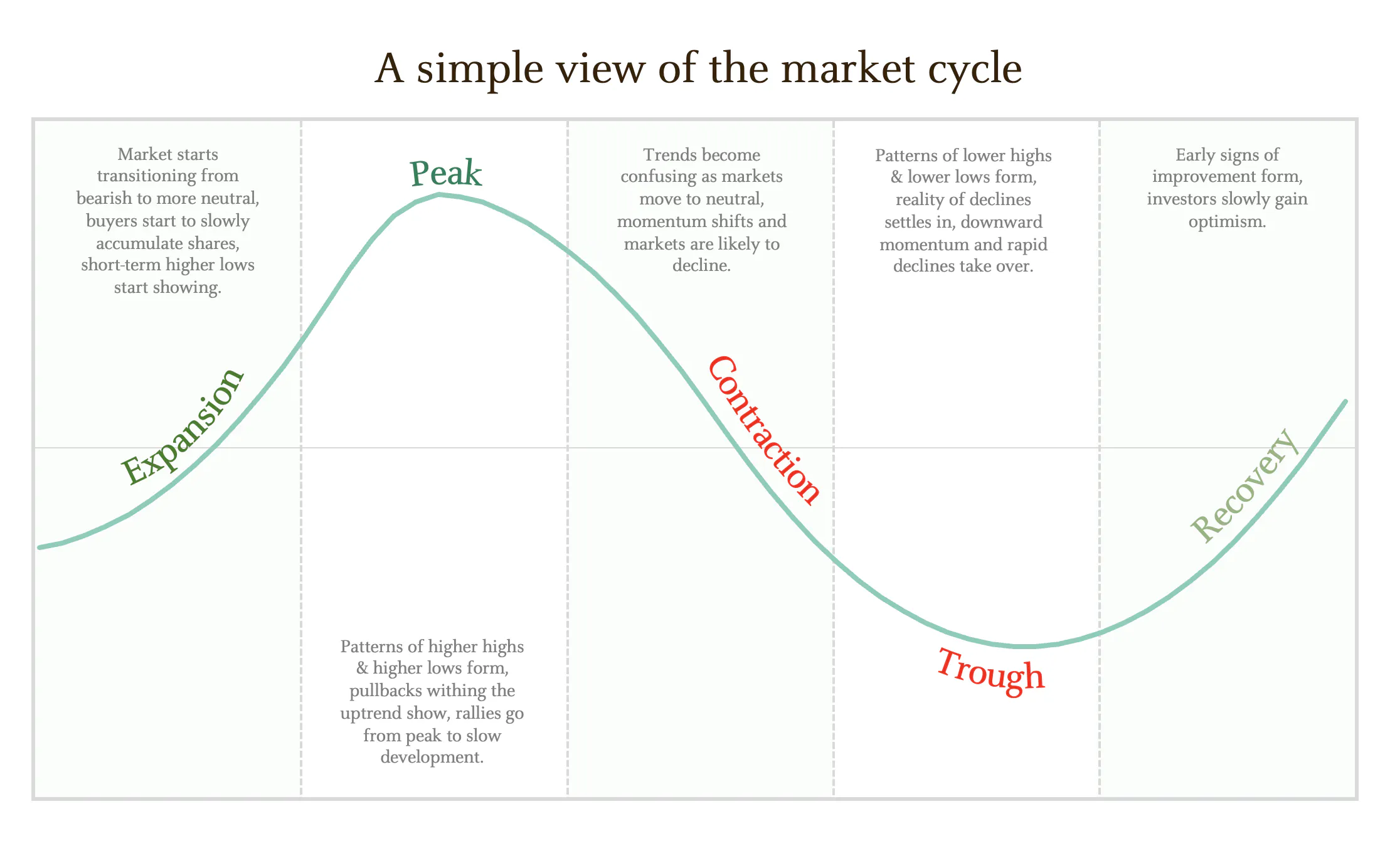
When investors talk about the broad phases of a market cycle, they’re often describing how market behaviour and investor confidence can shift over time. These phases aren’t fixed steps, and they don’t come with a schedule, phases can also overlap or look completely different each time.
Common phases of a market cycle are:
Expansion
Characterised by economic activity generally improving, strong company earnings, and rising investor confidence. This phase is often associated with bull markets. Prices tend to trend upwards during this period, however there can always be pullbacks.
Peak
Characterised by growth and optimism being stretched. Valuations start to look high and risk tolerance generally increases during this period. However, markets tend to become more sensitive to bad news.
Contraction
Characterised by slowing economic activity, falling earnings expectations and rising uncertainty. This period is often associated with bear markets. Prices tend to trend downwards and volatility is on the rise.
Trough
Characterised by weak market conditions and a broadly pessimistic view. However, markets slowly start to stabilise and may start setting stage for the next recovery. This is also known as ‘bottoming out’.
Recovery
Characterised by early signs of improvement, investor confidence rebuilding and signs of the wider economy slowly rising. This period is seen as a transition back into expansion.
What are bull markets?
A bull market is a market scenario with a sustained increase in the price of a major index.
While not a formal ‘definition’, a widely used metric for a bull market is a 20% or more increase in an equity market index (from a recent low) and high investor optimism (sentiment). However, bull markets are not only an equity market phenomenon. A bull market can occur in other asset classes, or may only affect one segment/sector of the asset class.
Bull markets generally refer to sustained rises over a period – often several months – rather than single market peaks.
Bull markets are typically a reflection of sustained optimism, but should not be interpreted as offering any assurance that prices can only go up.
Related terms that can be linked to bull markets:
- Market rally – A shorter-term rise in prices, often sharp. It can happen within a longer bull market, or it can be a temporary move inside a broader decline.
- Risk-on or ‘constructive’ – Investors may refer to themselves as being ‘constructive’ on risk, or having a ‘risk-on’ tilt/bias. These terms generally mean the same thing: the investor is comfortable investing in so-called ‘risk assets’ – most usually equities – as opposed to other asset classes like bonds.
What are bear markets?
A bear market is a market scenario with a sustained decrease in the price of a major index, usually from a moderate or high valuation level. A widely used metric for an equity bear market is a 20% or more decrease (from a recent peak) and pessimistic investor mood. Bear markets can however occur in other asset classes, and may only affect one segment/sector of an asset class.
Two related terms that can be linked to bear markets:
- Correction: A correction is not a bear market. A market correction is often considered to have occurred in an equity market if it has experienced a fall of around 10% from a recent high (also a rule of thumb, not a rule). This decline can happen within a longer rise or fall, but does not offer any indication of future market movements.
- Drawdown: A fall from a previous peak to a later low, over a period of time.
Some indicators of a bear market could be weak corporate earnings, slowing economy, falling asset prices and low investor confidence in the market.
Investing during bear markets:
Bola Onifade, Portfolio Manager at J.P. Morgan Personal Investing, recommends, “you should try to keep the long-term outlook in mind. Not reacting to aggressive market movements, which can be sentiment-driven and not reflective of the fundamentals, can help you make more planned decisions”.
More extreme market scenarios to know
Booms and bubbles
A market boom refers to a rapid or long sustained increase in prices alongside rising optimism.
A bubble is when price action gets more volatile, specifically with very strong positive momentum which isn’t driven by fundamental factors such as earnings growth.
Crashes, panic and capitulation
A crash is usually defined more by speed and disorder, than by a specific percentage move. Panic selling or refers to moments when fear appears to overwhelm decision-making. This may in turn lead to capitulation which is a late-stage turning point in a sell-off where investors give up (emotionally and/or financially) and sell after holding on for a while.
Investing with clarity when markets move
Financial markets will always move; sometimes smoothly, often not.
The terms explained above are a guide to a shared investor language. Understanding what they mean can help you understand what you’re seeing without feeling that every bump in the road requires a reaction.
Markets will move as part of a longer investment journey. Your portfolio can be seen as the vehicle you’ve built to help you reach your goals. Diversification can help reduce the impact of any one part of the portfolio, but it cannot prevent losses – especially when broad markets fall.
And remember, if you become worried, you can come back to our investing principles to help you keep on track.
When to get help: If you’re not sure what to invest in, don’t have the time to stay on top of it, and prefer a hands-off approach, managed investing may be a better fit.
Risk warning
The longer you stay invested, the more time your money has to grow. Investments go up and down, so at times you could get back less than you invest. Past performance and forecasts are not reliable indicators of future performance. We do not provide investment advice in this article. Always do your own research.
Past performance and forecasts are not a reliable indicator of future performance. We do not provide investment advice in this article. Always do your own research.