Investing for beginners – How to get started with investing
Investing can feel intimidating at first, but it doesn’t have to be. This beginner-friendly guide to investing is designed to walk you through the basics: what is investing, why should you invest, the different ways to invest, and the key questions you should ask yourself before you start.
Authors:
Navisha Joshi | Andrew Lacey
Last updated: 22 June 2026
At a glance
- Understanding the basics of investing, the key benefits it offers and the risks involved.
- Investing for the long term to balance risk and reward.
- Prioritising capital growth or income over the long term to meet your financial goals.
- Using different asset classes such as equities and bonds to manage risk and balance portfolios.
Whether you are new to investing or just want to learn more, we are here to help you feel more confident and in control of your money.
Prefer to speak to someone?
Book a free call with us.
Our wealth experts can help you understand which products could work for you. We help you work out your risk appetite and how that could affect the investments in your portfolio.
What is investing?
Investing is the process of putting your money to work, so it can grow over time.
With investing, you are essentially buying a piece or the whole of something such as a company or a property with the aim that it will be worth more in the future. In return, you may make or earn:
- Capital gains: The profit earned from the difference between the price you paid for an asset and the price you sell it for.
- Income: Regular payments earned through various methods such as dividends, rent on properties or interest from bonds.
Some common types of investments (assets) are:
- Shares (equities): Units of ownership in a company.
- Bonds: A form of debt issued by companies and governments to borrow funds from investors, usually for a fixed term.
- Funds (Exchange Traded Funds or mutual funds or investment trusts): Pooled investments that comprise a mix of assets.
- Commodities: Exposure to physical goods such as gold, crude oil or agricultural products.
- Real estate: Property bought to earn rental income and/or with the expectation of a rise in value.
- Cash and cash equivalents: Easily accessible instruments such as money market funds.
When you invest, you aim to protect your cash from inflation by allocating it across different assets that may appreciate over time. This way, investing can help your money grow faster than inflation, helping you build long-term wealth.
Before you start investing, you need to remember some golden rules:
- Setting up investment goals: Answering questions such as ‘how much should I invest’, ‘for how long do I need to invest’ and ‘what am I investing for’ helps you set up your investment goals and time horizons.
- Start early: We advise time in the market over timing the market. Staying invested for longer gives you the opportunity to benefit from compounding.
- Diversify: Spreading your investments across different assets rather than putting all your eggs in one basket can help manage risk.
What is the difference between saving and investing?
Saving means putting your money aside for later use, usually with a focus on capital preservation, liquidity (ease of sale), and easy access. These funds could be stored in cash accounts with banks or building societies (which may be eligible for deposit protection up to applicable limits), or in other savings products.
Cash savings may be best suited for:
- Emergency funds
- Short-term goals
- Money that you cannot afford to lose
Savings accounts offer interest. However, one downside is that these interest payments may not increase at the same pace as the cost of living, so your money may not keep up with inflation over time. This means that your money is growing slowly and is therefore prone to inflation’s erosion effect.
Investing, on the other hand, puts your money into different assets with the expectation that their value will grow over time. Although this involves different degrees of risk based on the assets chosen, the risk and reward trade-off can help reduce the impact of inflation. The types of risks involved with both investing and cash are different. Investing carries the risk of your capital potentially falling in value, particularly in the short term. Cash carries the risk of potentially losing its purchasing power to inflation.
Investing may be best suited for:
- Long-term goals (such as retirement, buying a house, planning for your child’s future)
- Growing wealth while beating inflation
- Money that you won’t need in the short term
The following table compares the main features of saving vs investing:
Parameter | Saving | Investing |
|---|---|---|
Risk | Low | Medium to high |
Potential reward (return) | Low but more predictable | Higher but less certain |
Accessibility (liquidity) | High, mostly immediate | Might take longer, less liquid |
Time horizon | Short term (0 to 3 years) | Long term (at least 3 years) |
Goal | Preserving money | Growing money |
Key takeaway: Which one should you pick?
Typically, both. A healthy financial plan usually involves building a comfortable savings cushion for your near-term expenses and then, if you can afford to, investing the additional money. Think of savings as a financial safety net and investing as your wealth-building engine. Together, both these practices can help you lay the foundation for a strong financial future.
Am I ready to start investing?
We believe investing should be open to the many, not the few. It does not matter how much experience you have or your level of wealth. If you are confident that you have sufficient cash savings for emergencies, you can consider investing.
Before you begin, go through this short checklist:
- Do I have enough emergency money? (we recommend between three and six months' essential spending)
- Have I cleared all outstanding debts? (such as credit card debts or personal loans)
- Can I comfortably stay invested for at least three years?
- Am I comfortable with the thought that my account value can go down as well as up?
Provided that you are aware of the risks involved, can cope with putting your money away for a few years, and are aware that the value of your investments can fluctuate, investing could be more effective in helping you achieve long-term financial goals than saving in cash alone.
Key takeaway:
Remember, there's no single right time to start investing, but getting the basics right in the first place means that you can invest with confidence and not anxiety.
We can help you explore your approaches, answer questions and understand your risk appetite based on your goals. Speak with our wealth experts for free financial guidance to find the right investment style that works for you.
What is my investment goal?
Before you dip your toes into investing, it is worth asking yourself one simple question: what am I actually investing for?
Having a clear goal shapes every decision you make; from how much to invest to how long to stay put for, and how much risk you’re willing to take on.
Why your goal matters
Every investor has a different profile, which means the timeframe and the approach that fits your financial plans will be different too. Two investors can both be planning for important goals, but might need very different approaches based on timing and flexibility. For example, someone nearing retirement in the next few years may prefer an approach that aims to reduce the impact of short-term market swings, whereas someone working towards a goal that is still several years away may be comfortable staying invested through more volatility. Knowing your destination can help you plan the right path, timeframe and risk tolerance required to get there.
Common investment goals
Goal | Key Considerations |
|---|---|
Balancing growth and protecting your deposit as you get closer to when you’ll need the money. | |
Starting early can help if you’re planning for upcoming family-related costs, such as childcare or future education expenses, especially when the goal is several years away. | |
A long-term approach helps you tackle risks such as market ups and downs early on, supporting more predictable withdrawals later. | |
Flexibility to grow your wealth over time and adjust as your circumstances change, while aiming to protect what you’ve built. | |
Managing the new money optimally and preventing emotional decision-making by taking time to plan before acting. | |
Using assets that may produce a consistent income (e.g., dividends or bond interest). |
One goal or many?
You don’t need to pick just one goal. Many investors have several goals lined up at the same time, for instance, wanting to build a retirement pot while also planning for your child’s education. The key is to clearly plan for each goal separately, including their individual timelines and deciding your investment amount and style for each accordingly.
Setting up a SMART investment goal:
A useful method for defining your investment goal is to make it SMART:
- Specific: Define what exactly is the aim for this investment?
- Measurable: What amount do you need to reach to fulfil your goal?
- Achievable: Is the goal realistically aligned with your income and timeline?
- Relevant: Does the goal align with your wider financial plans?
- Time-bound: When do you need the money for your goal by?
For example, rather than “I want more money”, a SMART goal might be something like “I would like to build a £50,000 deposit for a new house in 8 years by investing £400 every month”.
Your goals may evolve, and that is fine. Life changes, and so will your investment goals. Therefore, we recommend regularly reviewing your goals, at least once a year, to ensure that your investments are aligned with where you are in life.
How much do I need to start investing?
One of the most common misconceptions about investing is that you need a lot of money to get started. While minimum investments vary depending on the platform you choose and the type of account you hold, most platforms allow you to start with a modest amount.
What do the industry offerings look like?
- Some platforms allow you to start with as little as £1, particularly those offering fractional shares (portions of a whole share).
- Most mainstream platforms typically require between £100 to £500 to open an account and start investing.
- Certain investing strategies, in particular those focused on generating income, may require a higher minimum investment.
The key takeaway here is that there is no universal minimum. What matters is that you find a platform that suits your goals and invest an amount that you are comfortable with.
How much should I invest?
The amount you can invest and the amount you should invest are two different concepts. The amount you can invest is what you can afford after covering essentials like bills, high‑interest debt, and an emergency fund, while the amount you should invest depends on what makes sense for your plans, timeline, and comfort with risk. The right amount for you depends on your own unique goals and needs. Here are some principles to help guide you:
Principle | What it means |
|---|---|
Only invest money you can leave invested | Do not invest money that you might need in the short term (the next 3 years). |
Let compounding do its work | The power of compounding is that growth can start to accelerate over time. As your investments grow, there’s a larger amount to earn future returns on. This way, compounding can help you grow not just what you originally invested, but also any gains you’ve already made – so long as those gains stay invested. |
Don’t wait for the ‘perfect’ amount to start investing | Starting with a modest sum of money today is almost always better than waiting until you have more to invest. |
Start investing with J.P. Morgan Personal Investing
At J.P. Morgan Personal Investing, we offer you a range of investment choices that cater to different goals and different starting amounts.
Account Type / Investment Style | Minimum Investment |
|---|---|
Managed Stocks and Shares ISA, General Investment Account (GIA) & Personal Pensions | £500 |
£100 | |
£100 | |
£10,000 |
*Our income investing strategy carries a higher minimum as it requires a larger base to deliver its income-focused goal effectively.
Capital at risk. Product rules apply.
Key takeaway: You don’t need to be wealthy to start investing. You can start with an amount that you are comfortable with and by staying consistent, give your money the time to grow.
What are the benefits of investing?
Putting your money to work rather than leaving it idle is key to long-term financial wellbeing. Whether your goal is to plan for retirement, protect your wealth from inflation or build a pot for your kids, investing offers a range of potential benefits.
1. It can help beat inflation
Inflation reflects how much the price of goods and services has risen over time. While a moderate level of inflation is normal in a healthy economy, inflation quietly erodes the purchasing power of cash. This means that the same amount of money will buy you less in the future compared to what it buys you now.
Investing helps you combat this by offering a potential for growth that outpaces inflation. It helps you protect the real value of your money. Let’s put that into perspective by looking at how some of our managed portfolios have performed against inflation:
Category | Annualised Return |
|---|---|
Fully managed portfolio (Risk level 6) | 5.70% |
Fully managed portfolios AUM-weighted performance (Risk Profile 0–10)* | 8.00% |
Inflation (CPI) | 3.56% |
*Assets Under Management (AUM) means the total pounds invested, and AUM‑weighted performance is the overall return calculated so that portfolios with more pounds invested have a bigger impact on the average. It explains how the average invested pound performed.
Source: J.P. Morgan Personal Investing. Performance and inflation figures are annualised for the period 30 April 2016 to 30 April 2026. Annualised return will show you the investment's average yearly performance over a given period, expressed as a percentage. It is compounded to show you the value on an annual basis rather than the given period to allow comparison of different assets equally. Over this period, inflation would have reduced the purchasing power of cash by 3.56%, while investment returns were higher. These figures refer to past performance, which isn’t a reliable indicator of future performance.
If you’re comfortable with taking on some level of risk, investing could be a good way to help protect some of your money against the effects of inflation.
2. It can make compound returns work in your favour
Compounding is sometimes called the ‘eighth wonder of the world’ and can be an investor’s best friend. The concept of compounding is simple: your returns generate their own returns. The earlier you start, the more you can potentially accumulate over the long term.
Here’s a quick example of how it works:
- Year 1: You earn a £5 return on a £100 investment → total £105
- Year 2: You then earn 5% on £105, which gives you £5.25 → £110.25
- Year 3: You then earn £5.51 → £115.76
- …and so on, your invested capital accelerates in value over time
*This example is for illustrative purposes only and uses a hypothetical annual return of 5%. Returns are not guaranteed and actual performance may differ. The effect of any costs and charges is not reflected.
Over decades, this snowball effect that compounding offers can be transformative in achieving long-term goals such as retirement. If you start early enough, it could mean that you have to invest substantially less each month than if you had started later – because compounding does the heavy lifting for you.
As always, investing is subject to the ups and downs of financial markets, so returns aren’t guaranteed every year. However, investing over a long timeframe could help make up for any shorter periods in which your portfolio's value falls, and give you the best chance of growing your money overall.
3. It can reflect your values
Investing doesn’t have to be purely financial, it can serve as an extension of your values. Concepts such as Socially Responsible Investing (SRI) allow investors to put their money behind companies or funds that align with their personal values. Approaches such as environmental sustainability, ethical governance, or social impact, can be a way to consider the broader impact of where your money is invested, alongside your financial goals.
4. It offers flexibility to meet your goals
There isn’t a one-size-fits-all approach to investing. It offers a range of different choices, from ISAs to pensions to general investment accounts, which can be used to support different objectives. As investors have varying goals, time horizons and risk appetites, you can build an investment plan that is genuinely tailored to you.
How involved do I need to be?
One of the biggest barriers for beginner investors isn’t money, it’s time. Many investors assume that investing requires constant attention, a deep understanding of financial markets, and hours spent in trying to monitor stock prices. The reality, however, is that investing doesn’t have to be that way at all.
The investing spectrum
You can pick how involved you wish to be based on which approach suits you best:
Approach | What it involves | Time range & involvement | Most suited for |
|---|---|---|---|
Guided / advisory | Making your own decisions but supported by professional guidance | Medium involvement – fairly regular check-ins required | Investors who wish to stay in control of their portfolios while seeking inputs |
Experts handle your portfolios and make decisions that fit your goals | Low involvement – involves fewer regular check-ins | Investors looking to leverage the expertise of professionals with deep industry knowledge |
Wealth Practice Manager, Paul Hillis, recommends that “if you are looking to take a cautious first step into self-directed investing, you might want to consider allocating 10% of your investable funds to a brokerage account while keeping the remaining funds managed by professional portfolio managers.”
The “I don’t have time” objection answered
If you have ever thought that ‘investing sounds great, but I just don’t have the time or knowledge to do it', managed investing is here to fill that gap. You bring the goals, we bring the expertise. With J.P. Morgan Personal Investing, getting started is straightforward. After setting up, your portfolio is in the hands of professionals who monitor investment markets every day, thus giving you the confidence that your money is being managed expertly.
How J.P. Morgan Personal Investing’s managed portfolios work
We offer a broad spectrum of investment styles to match your goals. Within our fully-managed category, our experienced investment team makes the ongoing investment decisions and adjustments for you. Here’s what that looks like in practice:
Your job:
- Completing a straightforward risk questionnaire to help us understand your goals and risk appetite
- Choosing an investment style, product and risk level that suits you
- Making your initial investment with us and optionally also setting up regular contributions
Our job:
- Building a diversified portfolio tailored to your investment style and risk level
- Monitoring and managing your portfolio on an ongoing basis
- Making portfolio adjustments based on rigorous analysis and investment research
Our portfolios are built using Exchange Traded Funds (ETFs), a cost-effective and efficient way to gain broad exposure across markets. The selection of these funds is carried out by our team of investment professionals, supported by the expertise of one of the world’s leading financial institutions – J.P. Morgan.
Stay informed without being overwhelmed
Being hands-off doesn’t mean being kept in the dark. Investing with us, you will always have visibility over how your investments are performing. Our team is here to support you if your circumstances or goals change. We also recommend reviewing your investment goals at least once a year to simply check that everything still aligns with where you are in life.
How does investing work?
When you invest, your money is put to work in financial markets through exposure to different assets. Understanding the building blocks of these markets is helpful for all beginner investors, whether you opt for a managed portfolio or choose to invest on your own.
What is an asset?
An asset, in investment terms, refers to anything physical or intangible that can often be bought and sold with the aim of generating a return. Professional investors categorise different kinds of investments into ‘asset classes’ based on certain characteristics. Asset classes include commodities, cash and real estate, among many others. The most widely used asset classes are equities and bonds, which trade in financial markets.
It's worth noting that not all assets carry the same regulatory protections. Investments offered through Financial Conduct Authority (FCA)‑regulated products may be covered by the Financial Services Compensation Scheme (FSCS), subject to eligibility and limits, whereas direct holdings such as physical property are not FCA‑regulated and fall outside FSCS protection.
Equities: Owning a piece of a company
When you invest in shares, you are buying a unit of ownership in a company. If the company prospers, the value of your shares can grow with it. Investors may buy shares to benefit from potential share price increases, to earn income through dividends (if the company pays them), or both.
Share prices are affected by a range of different microeconomic and macroeconomic factors, including a company's performance, the industry it operates in and the broader economic and market outlook. While this may feel intimidating in the short term, historical data shows that equities tend to rise in value over the long term.
The chart below shows the long-term performance of the MSCI All-Country World Index – a global equity benchmark that covers stocks from both developed and emerging markets.
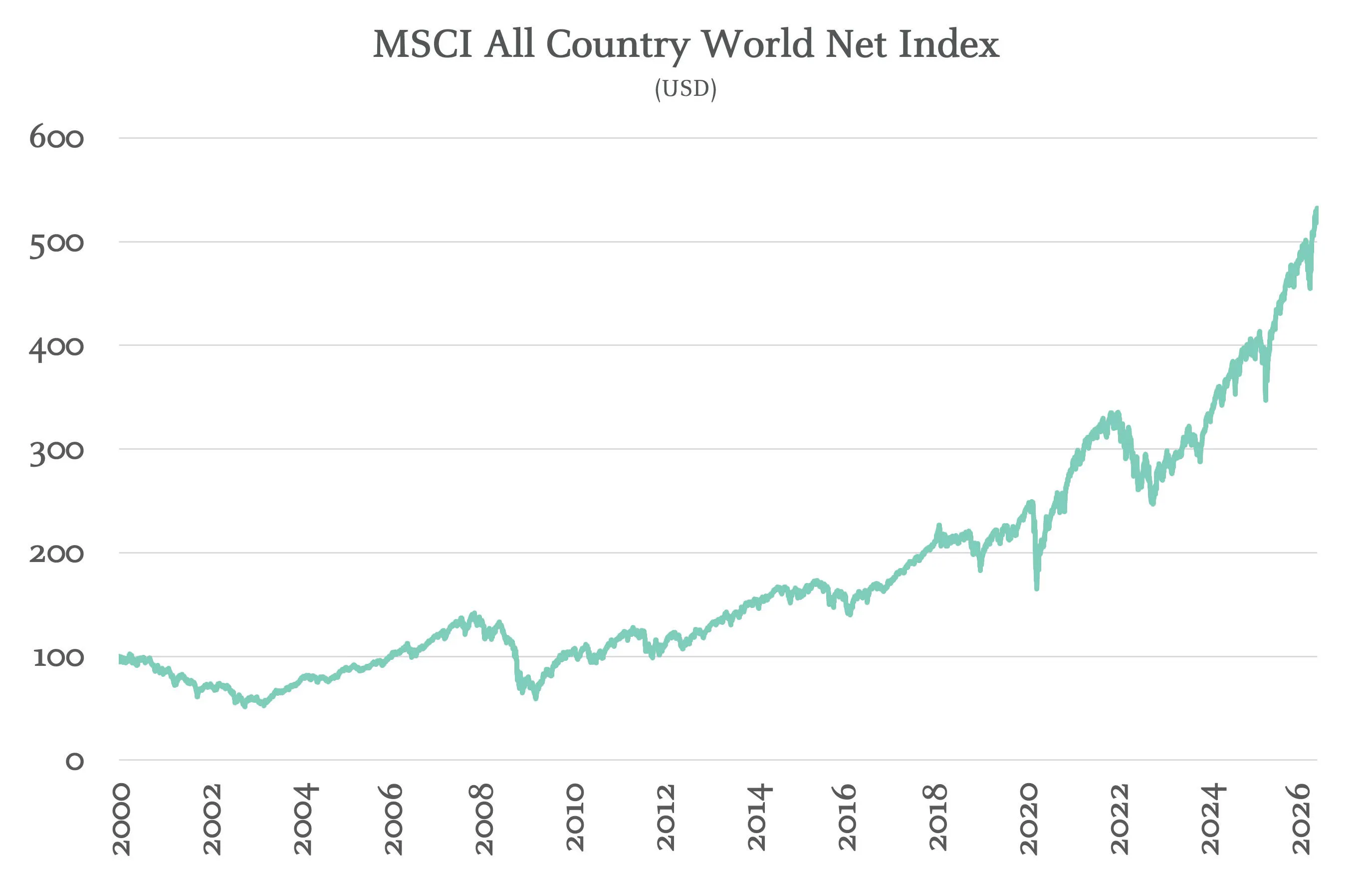
Source: J.P Morgan Personal Investing (Macrobond Data), May 2026. MSCI ACWI Net Total Return USD Index at end of day, rebased to 100 at 31/12/1999. Past performance isn’t a reliable indicator of future performance.
Bonds: Lending to governments and companies
Bonds work differently from equities as they are a form of debt. They are ‘issued’ by companies and governments around the world to borrow money from investors for a fixed term, in exchange for interest.
Bonds typically pay a return to investors in the form of ‘coupons’, until such time as the bond 'matures' and the sum initially borrowed from the investors is returned. Because bonds typically represent a predictable flow of returns, they are often considered to be lower risk than equities. The trade-off is that historically, bonds have returned less than equities over the long term. Bonds are also more sensitive to interest rate changes and expectations for future inflation.
How equities and bonds work together
Most investment portfolios hold a mix of both equities and bonds. The balance between these two asset classes is one of the key levers in shaping the risk level of a portfolio. They can roughly be categorised as follows:
Parameter | Equities | Bonds |
|---|---|---|
Potential return | Higher | Lower |
Risk level | Medium to high | Lower to medium |
How you may make money | Increase in share price or dividends (variable) | Coupons (fixed) |
Best for | Long-term growth | Stability and income |
Sensitive to | Company performance, economic growth, and market sentiment | Interest rates and inflation |
ETFs: Baskets of securities
Think of Exchange Traded Funds (ETFs) as baskets of securities that allow you to invest in multiple assets at once. Rather than buying an individual share or bond one by one, an ETF allows you to gain exposure to many assets through a single investment.
An ETF can track (follow the performance of) an index like the FTSE 100 or focus on specific asset classes, regions, sectors or market segments. What makes ETFs particularly suitable for beginner investors is that they are:
- Low cost: ETFs are one of the most affordable investment vehicles
- Transparent: Investors can easily check the holdings of each fund.
- Flexible: ETFs trade like shares on the market and can be bought and sold easily.
- Diversified: By spreading exposure across multiple assets, ETFs serve as a diversified investment vehicle.
Diversification is one of the golden rules of investing, and ETFs make it an accessible choice for everyone, not just those with large sums to invest.
At J.P. Morgan Personal Investing, we build our managed portfolios using ETFs due to their many benefits.
Key takeaway:
Investing works by putting your money into different investments – primarily equities, bonds or funds – that have the potential to grow in value or generate income over time. Understanding these instruments can help you make informed decisions.
Do you pay tax on investments?
The short answer is: yes, but the amount of tax you pay depends on how you invest. The good news is that with the right account structure, it is entirely possible to invest in a highly tax-efficient manner or even tax-free.
Two main taxes to be aware of
Before you look at how to minimise tax, let us answer the common question of ‘how are my investments taxed?’:
Tax | When it applies |
|---|---|
When you sell an investment for profit, that is, sell it for more than what you paid for it | |
When investments generate income for you. This may be in the form of dividends or interest |
Both of these taxes are subject to personal allowances and thresholds. The amount of tax you pay depends on your own individual circumstances. Tax rules can also change, therefore, it's always important to stay informed or seek independent financial advice if you’re unsure.
Tax-efficient ways to invest: ISAs & Pensions
In the UK, if you invest using an Individual Savings Account (also known as an ‘ISA’), you do not have to pay tax on the returns you make. ISAs are a tax-efficient way of investing, and there are different kinds available:
ISA type | Annual allowance | Best for | Key considerations |
|---|---|---|---|
£20,000 | General long-term investing | Tax-free investment returns (within the allowance) | |
£4,000 (part of the overall £20,000 ISA allowance) | Buying a qualifying first home or saving for retirement | A 25% government bonus* on your investments | |
£9,000 | Investing on behalf of your child or a child you have parental responsibility for | Contributions do not count towards your personal ISA allowance; rules apply |
*There are eligibility rules for LISAs, and government withdrawal charges may apply. The qualifying age to withdraw funds from a LISA penalty-free is 60 years.
If you exhaust your ISA allowance, you can then look into a General Investment Account (GIA). However, you may have to pay tax on any returns you make through a GIA.
Pensions are also a tax‑efficient way to invest for retirement in the UK. Most contributions receive 20% basic‑rate tax relief (with potential additional relief for higher‑ and additional‑rate taxpayers). Investments can grow largely tax‑free inside the pension and withdrawals are usually taxed as income (though up to 25% can often be taken tax‑free). You can typically contribute and get tax relief on the lower of £60,000 a year and your relevant UK earnings, or £3,600 gross (£2,880 net) if you have no relevant earnings. You can normally access a defined contribution pension from age 55 (rising to 57, currently scheduled for April 2028).
How do I start investing? A step-by-step guide
Step 1: Get your foundations in place
Before you invest even a single pound, you may want to make sure that the basics are covered:
- You have an emergency fund worth 3 to 6 months of essential expenses set aside
- You have paid off any high-interest debts such as credit cards
- You can comfortably leave this money invested without needing it for at least 3 years
Step 2: Define your goal
You now need to ask yourself: what am I investing for? Whether you’re planning for your retirement, looking to buy a home, building long-term wealth or saving for your children’s future, having a clear investment goal will shape every decision that follows. How much you invest, how long you invest for and how much risk you’re comfortable with all depend on your financial plans and goals.
Step 3: Work out how much you can invest
With your goals in mind, you can decide on a starting investment amount and whether you would like to make regular contributions. Even small yet consistent amounts can grow significantly over time with the power of compounding. Remember, you don’t need a large sum of money to start investing.
Step 4: Understand your attitude to risk
Investing carries risk. But it also carries the potential for reward. There are three ways you can think about risk in the context of investing for the first time.
- Your tolerance for risk: Over the short term, the value of your investments can go up and down. How comfortable are you with this?
- Your capacity for loss: What can you afford to lose in the short to medium term?
- What you’re investing in: Different assets have different levels of risk. High risk assets usually have higher rates of return over the long term, but a higher possibility of loss, and vice versa.
As an investor, while you can't control the markets, you can control the amount of risk you want to take. Changing your risk profile should be determined by your personal circumstances, rather than market movements. Choosing the right level of risk for you can make it easier to stay on track to achieve your goals.
Step 5: Choose how you want to invest
There are different levels of involvement you can choose to opt for when investing for your goals:
Approach | What it means |
|---|---|
Guided (Advisory) | You invest with professional support and advice |
Fully managed (Discretionary) | Experienced professionals manage your portfolio for you |
A fully managed investment account offers access to professional portfolio management, without requiring deep market knowledge.
At J.P. Morgan Personal Investing, we're all about helping you to make the most of your money and plan for your future, in a way that works for you. Speak to our experts to find out more, at a time that works for you.
Step 6: Choose the right account
As we learnt in the tax-efficient investing section, choosing the account you invest through matters. For most UK investors, an ISA is a natural starting point owing to its tax-free benefits. You can choose which ISA to use based on your goals or even opt for other account types:
- Stocks and Shares ISA: For general long-term investing
- Lifetime ISA: For your first home or retirement
- Junior ISA: For investing on behalf of a child
- Pension: For retirement planning with added benefits of tax relief
- General Investment Account: For when you max out your ISA allowances
Step 7: Open your account and make your first investment
Once you’ve chosen your investment approach and the desired account type, it's time to start investing. With J.P. Morgan Personal Investing, the process is straightforward. For managed portfolios, here’s the steps you’ll follow:
- Complete our risk questionnaire to help us understand your goals and attitude towards risk.
- Choose your investment style and risk level so we can match you to a suitable portfolio.
- Make your first investment starting with as little as £100 (for a LISA or JISA).
- Set up regular contributions as an optional yet powerful step to help build wealth over time.
- Let our investment team take it from here. They’ll now monitor and manage your portfolio so you don’t have to.
Step 8: Stay the course
Staying the course is just as important as starting to invest. Here are a few habits to build from day one in order to reap the benefits of investing:
- Review your goals annually: It is important to regularly check if your goals still make sense and align with where you are in life.
- Keep contributing regularly: The power of compounding can be unleashed through consistent investments, regardless of the amount.
- Don’t panic during downturns: Markets move, they may rise or fall. It is important to avoid emotional decision-making during the short-term dips in asset prices in order to achieve returns in the long term.
Begin investing with J.P. Morgan Personal Investing
We offer a range of portfolios that are transparent, globally diversified, and managed by our highly experienced investment team. You can choose your risk tolerance, pick an investment style, and leave us to select and manage your investments.
Risk warning
As with all investing, your capital is at risk. The value of your portfolio can go down as well as up and you may get back less than you invest.
Tax rules vary by individual status and may change. J.P. Morgan Personal Investing does not provide tax advice. For personalised advice tailored to your specific situation please consult with a qualified tax adviser or financial planner. ISA, LISA, JISA and pension eligibility rules apply.
We provide 'restricted advice', which means we will only make investment recommendations on the products and services that we offer.
With income investing, income isn’t guaranteed and may fluctuate. GIA/ISA only.
If you are unsure if investing is right for you, please seek financial advice. Please note that our offerings do not include all investment products and asset classes referred to here, such as real estate or commodities.
Past performance and forecasts are not a reliable indicator of future performance. We do not provide investment advice in this article. Always do your own research.