How to handle market volatility as an investor
Market volatility is a common term in financial markets that describes the rise and fall of investment prices. This guide explains what it is, what can drive it, and how to think about decisions when markets feel unsettled.
Authors:
Navisha Joshi | Euan Jones | Alex Janiaud
Last updated: 6 November 2026

At a glance
- Volatility is how much prices move up and down over time; higher volatility means bigger swings.
- Volatility is normal in investing and often rises around uncertainty such as unexpected news, economic data, interest-rate decisions and geopolitics.
- Big market moves can feel unsettling, but it can help to focus on what you can control: your timeframe, diversification and risk level.
- Should you need the money soon, short-term volatility may matter more than if you’re investing for longer-term goals.
What is market volatility?
Volatility relates to the change in value of an asset, and can be reflected by how much its price rises and falls. In technical terms, it is often measured using the standard deviation of returns (how widely returns vary around their average).
The value of all financial markets changes over time, with some asset classes such as equities and bonds even changing value throughout the day in the wider financial system. Assets regarded as highly volatile are likely to fluctuate in price over a short period of time, while the value of a low-volatility investment is generally more stable.
Volatility vs risk
Volatility and risk are related, but they are not the same thing.
- Volatility describes the size and frequency of price movements, or in other words, how bumpy the journey is.
- Risk is the chance of a bad outcome. For example, losing money you cannot afford to lose, having to sell at an unfavourable time or not being able to reach your goals.
Volatility is one component of risk, but it is not the full story. An investment can be volatile and still deliver positive returns over a period of time. A less volatile investment can still lose value. What matters is understanding whether the ups and downs fit with your timeframe and what you need your money to do.
What causes market volatility?
Markets move for many reasons, such as new economic data, political events, interest-rate expectations, central bank announcements, company earnings, or geopolitical shocks like war or energy shortages. These variables impact investor sentiment and market narratives. Investor sentiment defines how investors feel (such as optimistic or fearful), while market narrative is the story that investors attach to market moves. Sentiment tends to be louder when a negative event or news comes emerges, causing prices to fall quickly and sharply.
If a large number of investors are trying to reduce their holdings in an asset class at the same time, it will have a bigger negative effect on the price. This is because for every seller, there needs to be a buyer on the other side of the trade. If sentiment is worse, the price of the asset must find the level at which it becomes attractive to another investor, which is likely to be lower than normal. Volatility is the outcome of these changing asset prices, which can happen more drastically on unexpected news and events.
To understand some of these market moves in detail, you can read our guide to markets in motion.
What can you do during volatile markets?
Market swings can be uncomfortable, especially when values fall quickly. While each period of volatility is different, it can help to focus on your timeframe, risk tolerance and staying in line with your goals.
You can’t control the news or how other investors react, but you can control how you respond. Big decisions made in the middle of a market shock are often driven by emotion rather than a clear plan. It is natural to be disappointed and potentially feel some anxiety if you see that the value of your portfolio has fallen. While it can be difficult to retain sight of the big picture when investing in volatile markets, it is important to remember that very few investors will have only ever seen a one-way upward journey.
For regular context on market events, you can also read our updates on markets, which are designed to keep you informed about how we view the investment environment.
If you’re investing for long-term goals
It may be easier to ignore some short-term disruption if you are investing for your retirement, which may be a long way off, or for a target you expect to be on the distant horizon. If your plan and risk level still match your goals, you may choose not to make changes during short-term turbulence. The probability of your portfolio increasing in value typically rises in line with a longer time horizon. You have longer to benefit from any returns compounding and there is time for any periods of market turbulence to settle.
If you may need the money soon
If you have been planning to cash in your investments for an upcoming property purchase, to help fund your imminent retirement, or for any other more pressing circumstance, we understand that a sustained period of volatility may impact you more. You may have concerns about your portfolio, and how your financial goals may be impacted by a period of market turbulence.
In that situation, it can be sensible to check whether the risk level of your investments still matches your timeframe and needs. If your circumstances have changed since you first set up your portfolios, or you would like to speak to us about any concerns you may have, we encourage you to book a call with our team to get free financial guidance.
How to reduce volatility (and why it can’t be removed completely)
If you are investing in financial markets, it is impossible to avoid volatility altogether – prices move, and sometimes they do so quickly and sharply. Investors cannot control or completely remove market volatility, but they can take some steps to reduce its impact on your portfolio.
Here are some ways investors attempt to reduce the ups and downs in a portfolio:
- Diversify your portfolio across assets. A mix of different investments can help in reducing reliance on any one market or sector. Learn more on building a balanced portfolio through our detailed guide.
- Match your investments to your timeframe. Money needed sooner typically has less time to recover from falls.
- Choose an asset mix that fits your risk level. Portfolios with higher exposure to shares, for instance, may fluctuate more than portfolios with more bond holdings.
- Rebalance over time. Rebalancing is the process of adjusting your investment mix back to your intended level of risk after markets have moved.
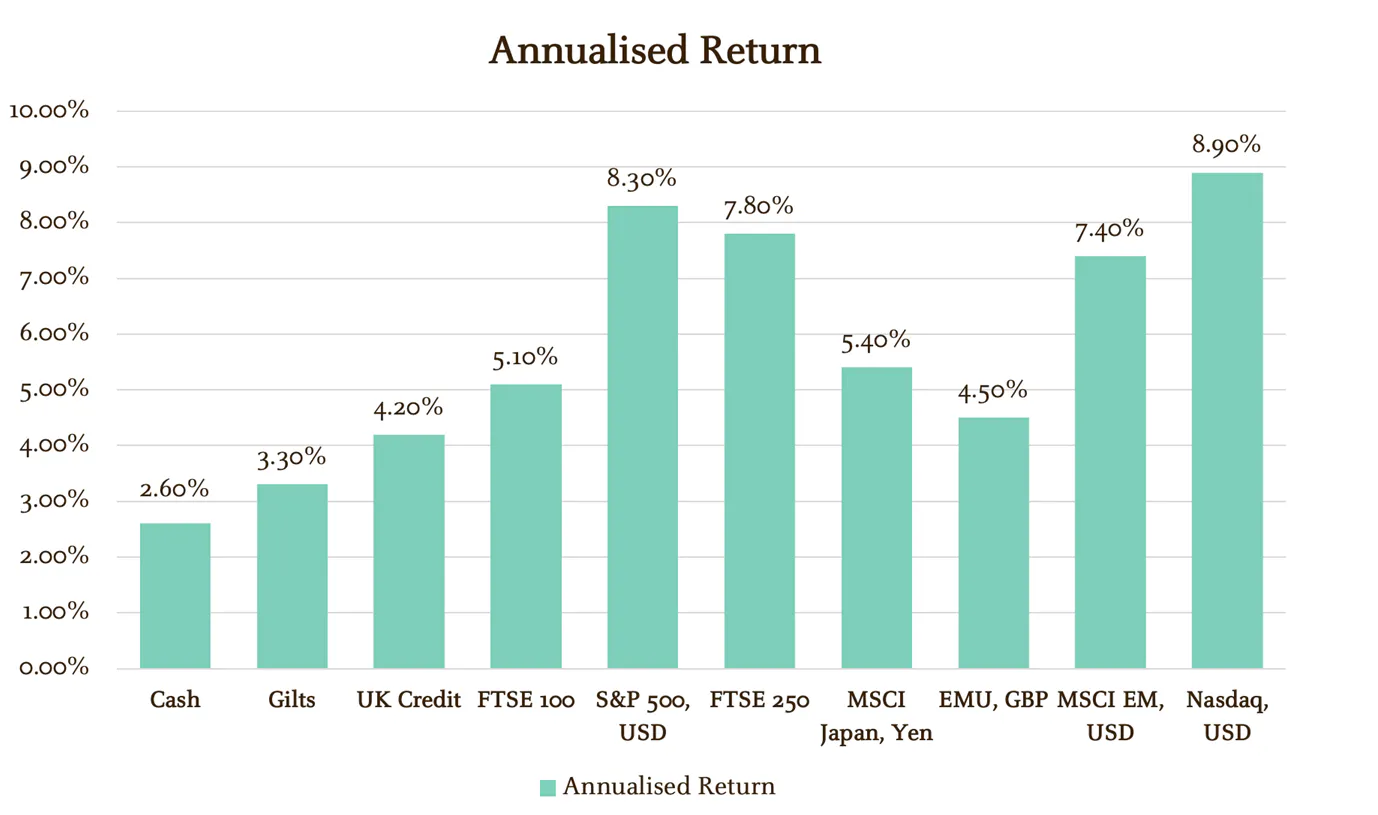
Reducing volatility is not the same as avoiding losses. Our investment principles can serve as a checklist for what to keep in mind during turbulent markets. Even a more cautious investment mix can fall in value. While past performance is no guarantee of future returns, history has shown us that volatility can be your friend should you take a long-term approach to investing. The below chart shows the annualised returns for selected equity and bond markets vs cash from (March) 2000 to (June) 2026. Although the relationship between risk and reward is not completely linear, as in not all those with higher volatility make higher returns, most asset classes below outperform holding cash by a significant margin over the 26-year period.
Note: Historic data can be a useful reference point, but it can’t tell you what will happen next. Past performance is not a reliable indicator of future performance, and you may get back less than you invest.
Should I sell when markets are volatile?
Markets can move quickly, which can cause portfolio values or index prices to change sharply. However, it is important to remember that a temporary fall in value only becomes a realised loss if you sell when prices are down. This does not mean that there is no real reduction in portfolio value, but that selling or holding the investments depends on your need for cash, long-term goals and risk tolerance.
If you’re considering selling during a period of volatility, it can help to separate the two questions:
- Do I need the money soon?
- Has my risk level stopped fitting my goals and circumstances?
If the answer to either of these is “yes”, it may be worth reviewing your approach. If the answer is “no”, some investors choose to step back and avoid making rushed decisions during market stress.
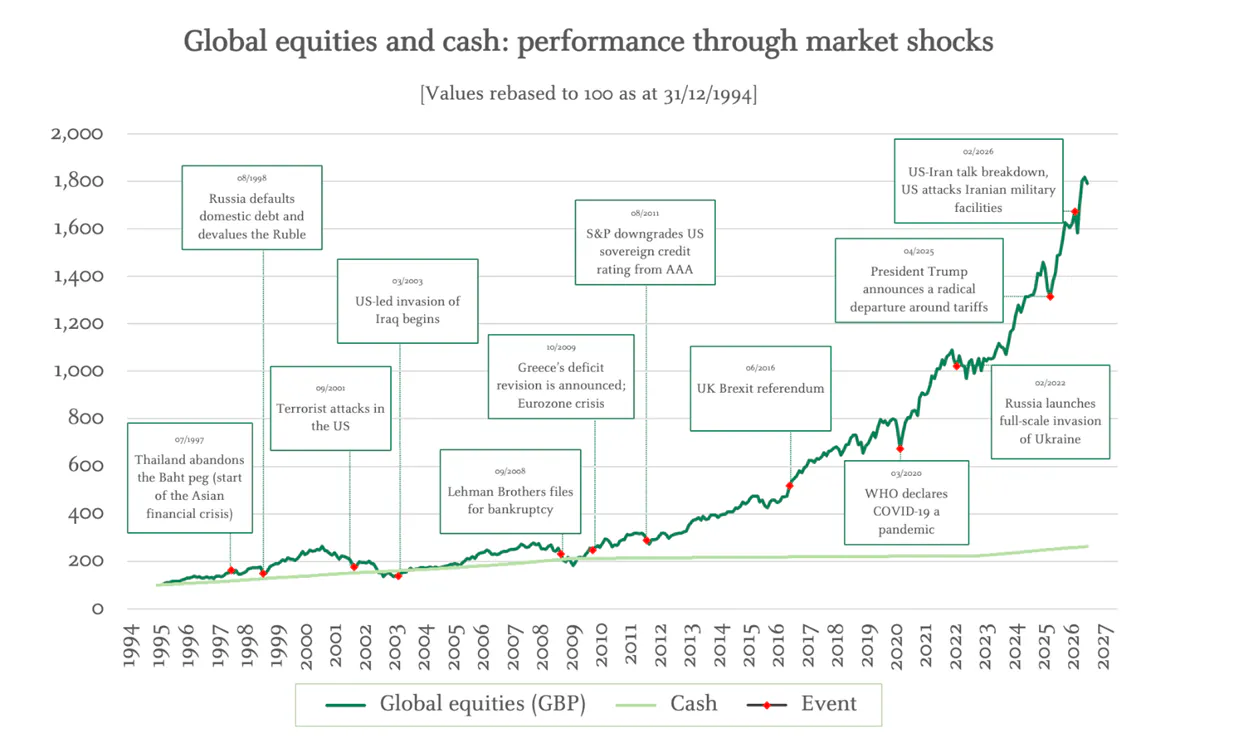
An investor may see their portfolio value move around more quickly than normal during a period of heightened market volatility, that same portfolio may not be down in value in a month’s time, or by the end of the year, for example. The chart below shows how global equities have fared over the past few decades as against cash. The graph for equities has broadly remained upwards despite high volatility and major events of market shocks.
If you’re feeling nervous about how recent financial market performance could affect your investment goals, our team is here to talk.
What should I do when investments fall?
A wealth manager’s perspective: Time in the market rather than timing the market
Paul Hillis, Wealth Practice Manager at J.P. Morgan Personal Investing explains that “it is disconcerting seeing investments fall, but changing risk levels based on market movements involves selling or buying, and effectively timing the market which is notoriously difficult. We’ve seen historically that those investors who invest for the long term, with an appropriate risk level, have had greater success than those trying to time the market in the short term. Our overall belief can be summed up that time in the market is more important than timing the market.”
“Rather than focusing on what has happened recently in markets, the risk level that may be right for you should be based on your individual circumstances such as your investing time horizon, capacity to take on risk and risk tolerance. J.P. Morgan Personal Investing uses a risk questionnaire with clients to help them determine their appropriate risk level, so they can be confident their Managed portfolio is being invested in a way that is consistent with their individual circumstances.”
When you choose to sell your investments depends on your own personal circumstances. However, if you have set a timescale and risk level that you are comfortable with, and these still apply to your current goals, then you have made sensible steps towards your financial future.
If you have been investing in financial markets for a long time, you will likely have experienced different periods of market stress and come out of the other side with some experience of what to expect.
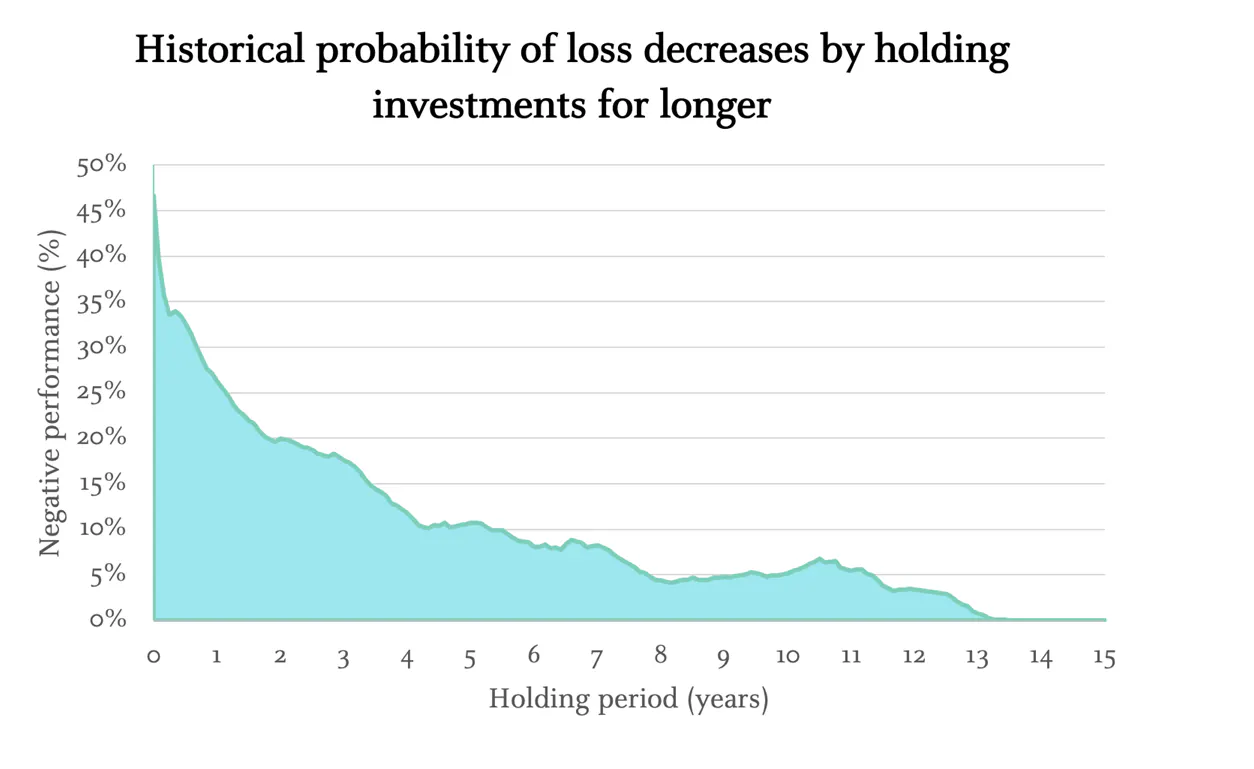
For those who are relatively new to investing in a globally diversified portfolio, making your way through the first period of market turbulence can be daunting. Your first year as an investor can be especially stressful because those first 12 months in isolation are more likely to show losses than when you have been invested over a longer timeframe. It’s completely understandable that volatility can cause stress, especially if you aren’t used to seeing negative figures when dealing with your finances.
However, as the chart below shows, the likelihood of making a loss should go down over time, and so too can those feelings of anxiety. What might seem like a big movement over a shorter time frame may be put into perspective when viewed over several years, though historical performance does not predict future returns. Here’s how the MSCI World Equity Mid and Large Cap probability of loss has fared (average) from 1972 to 2026, by the number of years invested.
How does J.P. Morgan Personal Investing manage portfolio risk?
Our investment experts closely monitor and analyse financial market data, economic data, and developments in the global policy landscape that can impact investments. This involves daily risk monitoring, ensuring that portfolios are well-diversified across asset classes and investing in ETFs that have been rigorously researched and selected to meet our standards for size, trading volume, and liquidity.
We make tactical changes to your portfolio's mix of investments to ensure that your portfolio remains aligned to your long-term objectives. We call this process rebalancing. Our Fixed Allocation portfolios are reviewed annually, while the rest of our portfolios are rebalanced more regularly as and when the team believes it is most appropriate.
However, our investment team has risk management at the heart of our investment process to manage portfolios’ exposures to volatility as effectively as possible.
We understand that appetite for risk can be highly personal. At J.P. Morgan Personal Investing we aim to understand your tolerance for risk, and ensure your portfolio is invested appropriately. If your financial circumstances have changed and you would like to discuss your portfolio with our team, please book a call for free financial guidance.
How different risk levels work
For the Fully Managed portfolios, for example, the risk scale of 1 to 10 primarily reflects the split, often called asset allocation, between perceived higher-risk assets (equities) and the bond market that has traditionally exhibited less volatility. Historically, equities have displayed greater price volatility than bonds, but also have demonstrated better returns over the long term. However, it should be remembered that past performance is not a reliable indicator of future performance.
For the lowest risk level 1, most of your money will be invested across developed market government bonds, the money market, or in corporate bonds. The vast majority of any equity exposure will be in developed markets, such as the US, UK, Europe, or Japan. Moving all the way to the highest-risk level 10, most exposure will be to equities, including emerging markets such as China and Brazil. Exposure to bonds will be more limited.
While equities tend to be higher risk and bonds tend to be lower risk, asset classes do not always perform to type. For example, 2022 was a particularly bad year for bonds as the world’s major central banks raised interest rates in a bid to control inflation. This is something to keep in mind when assessing your portfolio: that when investing, nothing is completely certain.
Managing portfolio risk: Managed vs Self-Managed investing
How we manage risk in Managed portfolios
Our investment experts closely monitor and analyse financial market data, economic data, and developments in the global policy landscape that can impact investments. This involves daily risk monitoring, ensuring that portfolios are well-diversified across asset classes and investing in ETFs that have been rigorously researched and selected to meet our standards for size, trading volume, and liquidity.
We make tactical changes to your portfolio's mix of investments to ensure that your portfolio remains aligned to your long-term objectives. We call this process rebalancing. Our Fixed Allocation portfolios are reviewed annually, while the rest of our portfolios are rebalanced more regularly as and when the team believes it is most appropriate.
However, our investment team has risk management at the heart of our investment process to manage portfolios’ exposures to volatility as effectively as possible.
We understand that appetite for risk can be highly personal. At J.P. Morgan Personal Investing we aim to understand your tolerance for risk, and ensure your portfolio is invested appropriately. If your financial circumstances have changed and you would like to discuss your portfolio with our team, please book a call for free financial guidance.
How Self-Managed investors can think about volatility
If you manage your investments by yourself, the same principles can apply. In volatile markets, common ways in which Self-Managed investors frequently review their approach are:
- Checking concentration: Are you heavily exposed to a single share, sector ore region that could potentially amplify swings?
- Reviewing your asset mix: Does your mix of investments, such as bonds or shares, still fit your timeframe and tolerance for ups and downs?
- Revisiting diversification: Is your portfolio well balanced and not relying on one theme of type of asset for most of your returns?
- Having a plan for rebalancing: If markets move sharply, do you need to adjust back towards your intended mix, and if so, when?
If you decide that the level of volatility you are experiencing does not sit well with your goals or comfort level, one general approach investors consider is whether a broader, more balanced mix (including lower-volatility assets) would be a better fit.
Note: We don’t provide advice or personal recommendations on individual investments. Please do your own research.
Key takeaways
Once you get to grips with volatility as a natural part of investing, with the understanding that the longer you invest, the less likely you are to see losses, this can help to ease some of the anxiety you may have about investing. The key points to remember when investing in volatile markets are:
- Volatility is about movement, not the outcome. Prices may swing sharply in either direction, especially around uncertainty.
- Your timeframe plays a role in your next action. For example, short-term dips may feel less significant if you don’t need the money anytime soon, thus staying put might be better.
- Risk tolerance must match the circumstance. It is usually easier to stick with a plan if the ups and downs are within what you can tolerate emotionally and financially.
- Shock-reaction decisions are hard to reverse, therefore pausing and checking against the big picture plan helps deciding the need for change.
No investment is ever guaranteed to deliver returns, but a measured approach over a sensible time horizon can help to maximise your chances of reaching your financial goals. If you do feel you would like to discuss your financial goals further, you can book a free call with one of our experts.
Risk warning
The longer you stay invested, the more time your money has to grow. Investments go up and down, so at times you could get back less than you invest. Past performance and forecasts are not reliable indicators of future performance. We do not provide investment advice in this article. Always do your own research.