What could steady interest rates mean for my investments?
7 min

Instability in the Middle East fuelled expectations of rising inflation and a pause in the recent cycle of interest rate cuts in major economies. This has since materialised in the UK, with the Bank of England (BoE) voting to hold rates this month. Before the conflict in Iran, the BoE had been expected to cut rates.
At a glance
- The Bank of England voted to hold interest rates at its monthly meeting, signalling a pause to the cycle of rate cuts
- The conflict in Iran unsettled financial markets and increased the likelihood of rising inflation, although the FTSE 100 remains ahead of where it was at the start of the year
- Equities and bonds are affected by movements in interest rates. It’s important for most investors to adopt a mindset of investing for the long term, however, and to avoid trying to time the market.
The Bank of England (BoE) voted in March to maintain its Bank Rate at 3.75% at the monthly meeting of its Monetary Policy Committee. In a statement on its website published on 19 March, the BoE said that “conflict in the Middle East has caused a significant increase in global energy and other commodity prices, which will affect households’ fuel and utility prices and have indirect effects via businesses’ costs”.
“Prior to this, there had been continued disinflation in domestic prices and wages,” it continued. “CPI inflation will be higher in the near term as a result of the new shock to the economy.”
Things have changed quickly since February, when the BoE’s Governor Andrew Bailey mooted the possibility of lowering rates as “a genuinely open question”, citing improving inflation data.
“This is a clear slowdown in the Bank’s rate-cutting cycle and shows some caution following the conflict in the Middle East over recent weeks,” says Director of Investment Strategy Brad Holland.
We are witnessing fast-moving events in Iran and the wider Middle East, and it’s important to avoid trying to pre-empt what might happen with too much certainty. Despite the recent volatility, the FTSE 100 remains ahead of where it was at the start of the year, while the S&P 500 and the Nasdaq – two key US indices – are only moderately lower year-to-date.
Regardless of what unfolds in the Middle East, now is a good time to understand the relationship between inflation, interest rates and investments.
With the end of the tax year fast approaching on 5 April 2026, it could still be a good idea to try to maximise your annual allowances if you can, despite the current market volatility.
Why might interest rates be held flat for longer?
Markets have undergone a period of volatility in response to the conflict unfolding in Iran. Stock prices have fluctuated, bond yields have jumped and the price of oil has spiked. We may be set for a period of rising inflation, which is the measurement of the increase in the cost of goods and services over time.
As the conflict has progressed, the price of Brent crude oil has moved above and below the $100 threshold, fuelling fears around energy costs. An increase in the price of oil and gas can have consequences beyond the cost of heating your home, as supply chains, transport and other fuel-dependent industries experience a lift in their own costs.
“The Bank faces a tricky challenge as it tries to interpret the mood music of the global economy after the start of the Iran conflict led to a spike in oil prices,” says Holland.
“By holding the Bank Rate, this suggests policymakers are keeping their options open as the conflict evolves and the endgame between the US and the Iranian regime remains unclear. While it is still early days in the conflict, if the price shock persists and creates an unwanted upward pressure on UK inflation, this could make it harder for the Bank to cut rates further this year.”
A central bank typically has a target rate of inflation – the BoE aims to keep the rate of inflation to 2% – and can lift its Bank Rate, which increases the cost of borrowing. Lifting the cost of borrowing is intended to curb spending, which in theory should help to reduce inflation back towards the Bank’s target.
How J.P. Morgan Personal Investing manages portfolios in light of interest rate uncertainty
As part of its ongoing macroeconomic and market analysis, our investment team works to anticipate and mitigate risk, while harnessing the long-term opportunities that changing inflation and interest rates may bring.
“At this stage, we do not envisage sweeping interest rate hikes by the major central banks,” says Holland. “It is very difficult to predict how this conflict will pan out,” he adds.
“Our portfolios are designed to withstand market shocks,” he continues. “We remain confident in our long-term investment strategies and do not intend to make significant changes to asset allocations for the time being.”
Increasing interest rates typically has a negative impact on equities, as companies reckon with the cost of higher borrowing, although the movement of equity prices can be influenced by a variety of factors. Bond prices, meanwhile, drop when interest rates rise.
The team can change the allocation of portfolios and their exposure to a variety of asset classes, including different equity markets and types of fixed income – both corporate and government bonds – depending on economic conditions. How this works in practice is dependent on your chosen investment style and risk level.
If rate cuts are now less likely, should I save or invest?
During a tumultuous period it might be tempting to withdraw some investments and remain in cash. However, it’s worth considering the relative returns of investments and cash.
Recent history indicates that cash is unlikely to outperform a multi-asset portfolio. J.P. Morgan Asset Management analysis of the periods following a selection of geopolitical and economic shocks since 1990 shows that a portfolio composed of 60% equities and 40% government bonds has outperformed cash more than 70% of the time over a one-year horizon. It has always outperformed over the three-year timeframes. Therefore, keeping money in cash has not always proven to be the best approach, although you should always do your own research and do what’s right for you. And of course, what has happened in the past does not necessarily indicate what might unfold in the future.
Hiding in cash is not usually the way to avoid geopolitical risk
Subsequent one-year and three-year returns over cash, following market shocks
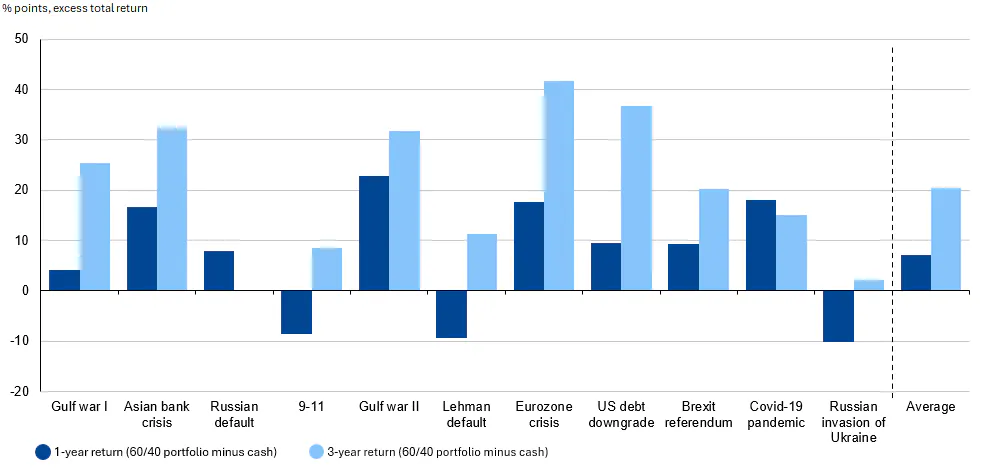
Source: Bloomberg, S&P Global, J.P. Morgan Asset Management. ‘0’ represents holding money in cash. 60/40 portfolio is constructed using S&P 500 Index and S&P 10-year US Treasury Note Futures Index. Cash: ICE USD LIBOR (3M). Return calculation begins at the end of the month prior to the shock. Data as of 30 November 2025. The 'Russian default’ 3-year return. which is too small to be visible in the chart, is 0.25%. Past performance isn't a reliable indicator of future performance.
What can I do to make the most of interest rate and inflation conditions?
- Consider a balance of saving and investing: save in a high interest account for short-medium term goals and invest for long-term goals. Be aware that keeping a large portion of your savings in cash during a period of heightened inflation leaves it vulnerable to being eroded in value.
- Determine your goals and, if investing is right for your goals, set an investment plan with a time horizon of at least five years – and stick to it. Don't try to time the market. Maximising regular contributions can have a big impact on returns through compounding. Particularly with the end of the tax year approaching, now could be the time to make the most of your annual allowances if you haven’t already done so. If you make a withdrawal, you will not get any of this allowance back.
- Talk to an expert. J.P. Morgan Personal Investing wealth experts can answer your questions in a free call, or if you prefer, pay a flat fee for a personalised investing plan tailored for you.
How we can help
If you need more information about different investments you can book a free call with a wealth expert from our team to discuss your options.
Our team can help you to get a clear view on different ISA and pension wrappers, as well as our investment styles. We can help you review your current strategy, and help you to make the most of your allowances. Get ahead with free financial guidance to set yourself up for success.
Risk warning
As with all investing, your capital is at risk. The value of your portfolio with J.P. Morgan Personal Investing can go down as well as up and you may get back less than you invest. Tax rules vary by individual status and may change. Seek financial advice if you're unsure if a pension is right for you. Always do your own research.
We provide 'restricted advice', meaning we only make investment recommendations on the products and services that we offer.