Don’t let Budget rumours derail your investing journey
10 min

Speculation around the upcoming Budget can unsettle investors and prompt knee-jerk changes. But reacting to policy rumours risks unnecessary costs, missed growth and tax consequences.
At a glance
- The Budget is a key moment for any government, and there is usually speculation about new rules and changes to policies in the weeks before the announcement
- Budgets can affect investments and how wealth is taxed, but should not materially change a long-term investing plan
- Making adjustments to your financial planning before policies are confirmed is unwise. Based on recent history, rumours and speculation don’t always translate into policy
- Whatever the Budget has in store, investors should focus on the basics of good financial planning, ensuring they have an up-to-date plan, are using tax free allowances, and are making use of expert support when needed.
Budget anxiety is understandable
The government has confirmed that this year’s Budget will take place on 28 October. Chancellor of the Exchequer John Healey will use the occasion to set out the government’s economic agenda. The announcement will include details on the government’s spending priorities and how it intends to fund these via several means, including taxation and borrowing.
In the weeks that lead up to the Budget, speculation will likely intensify over its contents. News outlets may report on and debate potential changes to policy and regulation, and this could include updates to rules governing investing, wealth and taxation.
This type of speculation likely unsettled UK investors last year, who pulled billions from equities in October and November in the lead up to the 2025 Budget, according to data compiled by funds network Calastone and reported by Bloomberg. These outflows reversed on 26 November – the same day as the Budget – as mooted policy changes weren’t announced, prompting some investors to return to the markets.
Investors may be considering whether to move their money, sell investments or delay decisions. But making decisions purely based on speculation can sometimes do more harm than good.
Rumours don’t always materialise
Prime Minister Andy Burnham used the first few weeks of his tenure to announce policies geared towards assisting with the cost of living, including a cap on bus fares and a cut to VAT on electricity bills. His political opponents have questioned how the government will fund his programme without increasing taxation or borrowing.
There has already been some speculation concerning areas of policy that could affect investors, such as changes to Capital Gains Tax (CGT) that could bring CGT more in line with taxes on income. While it’s important to stay abreast of the news, you should be wary of pre-empting changes to government policy.
It’s worth noting that in recent years, there have been a number of rumoured policy changes that didn’t materialise, including changes to gifting rules. Speculation can, however, translate into policy.
The case for staying invested
It may be tempting to withdraw money from investments ahead of a fiscal announcement. Markets rise and fall, and while it’s true that markets could react positively to the Budget, they could also respond negatively, prompting a decline in equities and spike in bond yields. This could affect the value of an investment portfolio in the short term. Depending on your circumstances – for example, if you are very close to making a substantial outlay – you may wish to take some action.
However, it’s usually not a good idea to withdraw your money in the lead-up to the Budget, for a number of reasons.
You may crystallise losses
Selling investments before the Budget may lock in losses or gains at an unfavourable time. Markets move in response to an enormous range of events beyond an upcoming Budget. We advocate spending time in the market instead of trying to time the market.
You could end up paying Capital Gains Tax
You may also trigger a CGT bill. Currently, individuals can make total gains of £3,000 per tax year on assets that they have sold or disposed of before they pay CGT, while gains made on the sale of assets in tax wrappers such as a Stocks and Shares ISA, Lifetime ISA (LISA), Junior ISA (JISA) and pension are exempt from CGT. But selling assets outside these wrappers and with gains above the CGT allowance in response to policy speculation could theoretically land you with an unnecessary CGT bill.
You may not get your annual tax allowances back
Depending on what kind of ISA you have, your annual tax allowances may not replenish when you withdraw your money. The current annual tax-free allowance for investing in a Stocks and Shares ISA, for example, is £20,000. If you withdrew £5,000, for example, from your J.P. Morgan Personal Investing ISA and subsequently changed your mind, you would not regain any portion of your annual tax-free allowance if you put your money back in, so you would have ‘lost’ the tax relief on that £5,000. You may then need to invest using a General Investment Account (GIA), within which gains are taxed at the point of sale.
Some providers offer a Flexible ISA, which does allow you to withdraw funds and then replace them without using up your tax allowance. J.P. Morgan Personal Investing does not offer Flexible ISAs.
Inflation can eat away at cash
It’s a good idea to have a cash buffer to support your spending needs as well as any unforeseen expenses. But keeping too much of your money in cash out of fear of what might be announced at the Budget risks inflation eroding its purchasing power over time.
A few days outside the markets could have lasting consequences
Spending even just a few days outside the markets can have damaging consequences for your portfolio and disrupt your long-term investing plan. Looking at a hypothetical $10,000 investment over the past 20 years, the below chart shows how staying invested could have significantly outperformed a strategy of moving in and out of the market during periods of turbulence. While past performance is not a reliable indicator of future performance, in missing some of the market's best days, investors can lose out on opportunities to grow their portfolios, resulting in a potentially harmful impact on overall returns. A fully invested $10,000 delivered annualised returns of 11% over the period, which was quite significantly ahead of an investment that missed even only the 10 best days in the market.
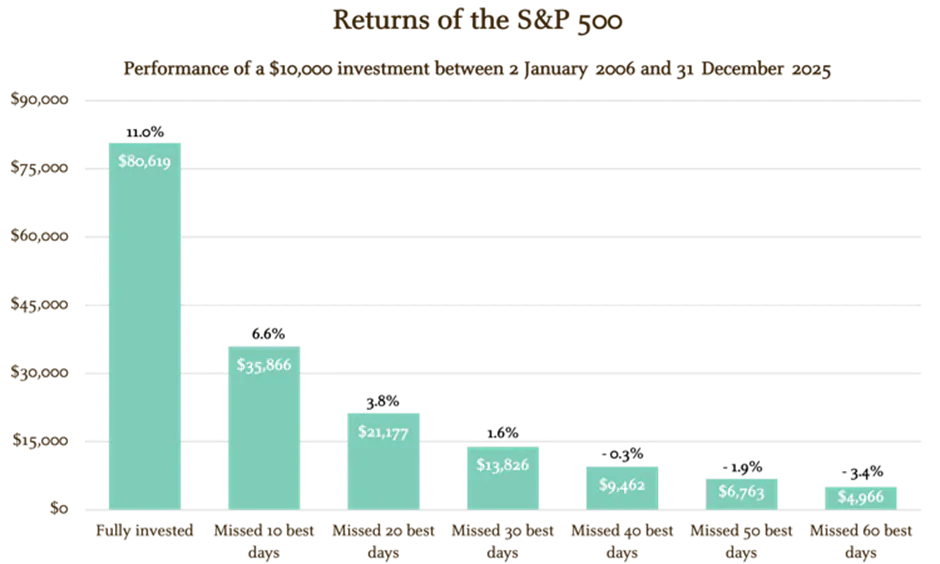
Source: J.P. Morgan Asset Management Guide to Retirement using data from Bloomberg.
Annualised return is the rate of investment gain or loss over a specific period expressed as an annual rate, to allow like‑for‑like comparison of investment performance. Returns are based on the S&P 500 Total Return Index, an unmanaged, capitalisation-weighted index that measures the performance of 500 large capitalisation domestic stocks representing all major industries. The hypothetical performance calculations (gross of fees) are shown for illustrative purposes only and are not meant to be representative of actual results while investing over the time periods shown. If fees were included, returns would be lower, and returns will fluctuate. Past performance is not indicative of future returns. An individual cannot invest directly in an index. Data as of 31 December 2025.
Policy may not be enacted on the day of the Budget
What’s more, policy may not necessarily come into effect once it’s been announced in the Budget, and may take time to be approved by MPs.
Once the Budget is confirmed, some changes to policy could be enacted immediately with MP support. MPs could be asked to approve some instant changes to taxes – tobacco and alcohol duties, for example, have been modified this way in the past. CGT and the tax-free allowance on dividend income are areas that could be changed quickly with the backing of MPs.
MPs will debate the Budget for a few days before being asked to approve any immediate changes to tax. Then, once passed, a Finance Bill will provide the legal basis for the Budget’s tax proposals. Any new tax or update to current taxes that the government wants to introduce before the Finance Bill is passed needs to be approved by Parliament within 10 sitting days of the Budget.
But please note that most changes tend not to come into force immediately, giving investors time to respond to the Budget. For example, the government announced a two-percentage point increase to tax on dividend income at its last Budget in November 2025. This only came into force at the start of the 2026/27 tax year.
Changes announced at the Budget will instead likely come into effect at the start of the next tax year, in April 2027.
“Tax rules matter, but they are only one part of a broader financial plan,” says Claire Exley, Head of Financial Advice and Guidance at J.P. Morgan Personal Investing. “If your investments were chosen to support long-term goals, a single Budget should not automatically change the plan.”
Investing little and often without interruptions for events like the Budget can help to build long-term wealth.
Steps you can take before the Budget
It’s worth staying up to date with news concerning the Budget, and J.P. Morgan Personal Investing will provide a summary of the announcement after it’s been released. In the meantime, there are some practical steps that you can take before the Budget.
- Review your goals
Check whether your investments still match what you are trying to achieve, such as retirement, income, wealth growth or supporting family. - Understand where your money is held
Consider the role of ISAs, pensions, GIAs and cash savings. - Avoid making rushed tax decisions
Selling assets before rules are confirmed can have consequences that mean you become liable for CGT. - Use allowances where appropriate
Customers may wish to review available ISA, pension and CGT allowances, depending on their circumstances. - Consider your retirement income plan
The potential for reforms to how wealth is taxed reinforces the importance of personal retirement planning. Consider getting a Personal Pension or upping your workplace pension contributions. - Speak to an expert
If you are unsure what the Budget could mean for you, you can access free guidance or get paid financial advice, both with J.P. Morgan Personal Investing.
We have published a summer investing checklist that could help you lower your tax bill, grow your pension and make the most of your annual allowances.
Speak to our wealth experts
You don’t have to navigate the Budget alone. Our wealth experts can explain what the Budget might mean for your investments, and help you explore how you could invest more tax-efficiently while making the most of your annual allowances.
We can work with you to explore your options, answer questions and discuss how you could use a combination of investment products. You can book a call to speak to one of our experts for free.
If you would like a personalised financial plan, we also have paid financial advice where we will review your finances and goals to help you build a financial plan with our recommended approach for you, based on our products and services.
Frequently asked questions
Should I sell my investments before the Budget?
This will depend on your individual circumstances, but usually the answer will be no. Selling in response to speculation can crystallise gains or losses at an unfavourable time, may trigger a CGT bill, and means you don't get your annual tax allowances back. Historically, many Budget rumours don't translate into policy, and time in the market tends to matter more than trying to time it.
When is the next UK Budget?
The Budget is due to take place on 28 October, when the Chancellor will set out the government's spending and taxation plans. Speculation about its contents typically intensifies in the preceding weeks.
Do Budget changes take effect immediately?
Not usually. Some tax changes (like alcohol and tobacco duties, or CGT) can be enacted immediately with MPs' backing, but most changes come into effect at the start of the next tax year, typically in April. This generally gives investors time to respond after policies are confirmed.
Will Capital Gains Tax change in the Budget?
It's unclear. There has been speculation that capital gains could be taxed more like income, which could affect investors selling assets outside tax wrappers. However, no proposal has been confirmed, and selling assets pre-emptively could crystallise gains unnecessarily.
Risk warning
The longer you stay invested, the more time your money has to grow. Investments go up and down, so at times you could get back less than you invest. Tax rules vary by individual status and may change. This is general information, not personalised tax advice. We do not provide investment advice in this article. Always do your own research. Our advice service provides 'restricted advice', meaning we only make investment recommendations on the products and services that we offer. Seek financial advice if you're unsure if a pension is right for you.