How to build long-term wealth by investing little and often
5 min

You don’t necessarily have to invest a large lump in order to build long-term wealth. Research by J.P. Morgan Personal Investing shows investors can build sizeable investment portfolios with small, consistent contributions.
At a glance
- A new survey by J.P. Morgan Personal Investing finds that most investors want to contribute over £1,000 per month towards their portfolios but fall short of this figure. They could start with lower contributions.
- Our wealth experts believe that investing smaller amounts more consistently can be a highly effective strategy for building towards long-term wealth goals.
- Investing £100 every month over the last 10 years into a global equity tracker would have made a significant difference to someone’s long-term wealth compared with staying in cash.
- Missing even a handful of monthly contributions over a decade can leave investors far short of their counterparts who invest every month.
- A monthly Direct Debit would make it easier to respectively build wealth and invest consistently, our survey respondents believe.
Investor ambitions outweigh reality
According to a new J.P. Morgan Personal Investing survey of 2,000 UK adults* – of which over 800 respondents were investors – 56% of investors contribute under £250 into their portfolio every month. But most want to invest at least £1,000 per month.
How much should you save before investing?
Setting aside £1,000 a month while adhering to other personal finance principles is a big ask, and isn’t possible for a lot of people. Before investing, it’s usually sensible to build a cash buffer, and we normally think it’s a good idea to be able to cover three to six months’ essential expenses in an easy-access account.
We think investors may be focusing more on how much they want to invest every month, and underestimating the power of consistency. Our research shows that only 27% of investors are regularly investing and could be missing out on the benefits of consistent contributions into their portfolio.
Doing what you can to keep up a regular investing schedule could make more of a difference than you realise.
Missed contributions add up
Had you invested £100 a month in a global tracker✝ for 10 years from May 2016, you could have accrued £23,826, according to our analysis of historical market data.
What’s more, the difference between investing consistently and missing even just a few contributions per year is stark. Over the 10 years to May 2026, an investor who missed four contributions a year would have been left with almost £8,000 less (£15,852) than the regular investor, despite only contributing £4,000 less over the period.
A regular cash saver, meanwhile – who’d contributed £100 every month over the same timeline into cash that tracked the Bank of England’s base rate – would be almost £10,000 short of the regular investor (see chart). This highlights the potential opportunity cost created by staying in cash, instead of investing in financial markets.
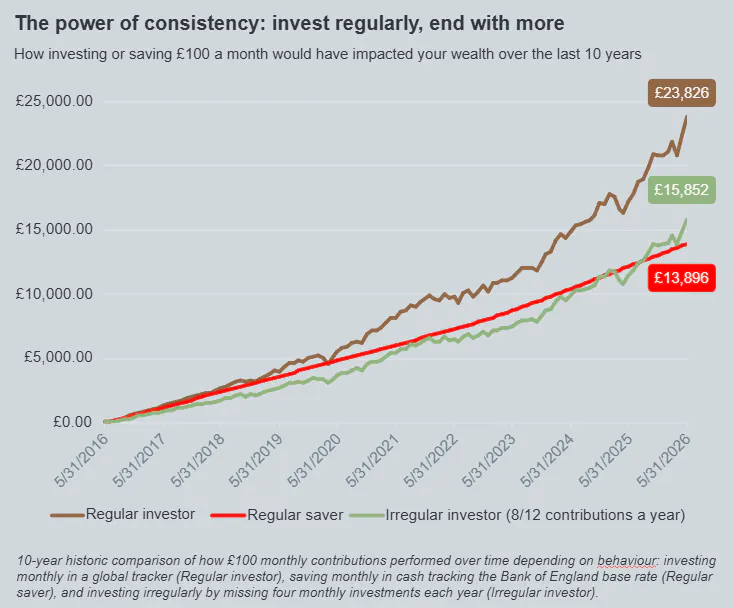
Source: J.P. Morgan Personal Investing. Past performance isn’t a reliable indicator of future performance. Calculations reflect nominal value (before inflation). No trading or platform costs included. ACWI management fee factored into account via Net Asset Value.
Investing £100 every month would represent a significant boost to the typical private pension in Great Britain. According to a study by the Office for National Statistics of household wealth in Great Britain, carried out from April 2020 to March 2022, the median savings total of adults with private pension wealth was £57,500.
“It can sometimes feel like a cliché when people say consistency is the key to forming good financial habits,” says Claire Exley, Head of Financial Advice and Guidance at J.P. Morgan Personal Investing.
“But it really is true,” she continues. “Good financial habits compound over time, work together and get you closer to your future money goals if you can stick to them. Regular investing is no different.”
With investing, it’s worth remembering that the value of your portfolio can go down as well as up and you may get back less than you invest. The chart nevertheless gives us a helpful insight into how an investment portfolio would have performed over recent times.
How to become a regular investor
Making regular investments is usually therefore a powerful way to build wealth, even if you don’t have thousands to put into a portfolio every year.
If you think you can afford to invest on a monthly basis, it could be a good idea to automate your investment contributions. According to our survey, 57% of respondents think that automated payments can make building wealth easier, while 62% of respondents agree that a monthly Direct Debit would help them stay consistent with their investing habit.
“If you decide to set up a monthly Direct Debit, consider timing it with your payday, to ensure that you’re investing before the month’s spending decisions compete for the same cash,” says Holly Graham, Senior Wealth Manager at J.P. Morgan Personal Investing.
“Once you’ve automated your investments, avoid checking them too frequently,” she continues. “Consistency and time in the market typically yield good investment outcomes over the long-term.
“Instead, consider reviewing your contributions on an annual basis, and increase them if you can afford to – particularly after an event like a pay rise.”
Speak to our wealth experts
Our wealth experts can help you to explore how to invest consistently while ensuring that you have enough cash to cover your expenses. You can book a call to speak to one of our experts for free.
If you would like a personalised financial plan, we also have paid financial advice where we will review your finances and goals to help you build a financial plan with our recommended approach for you.
Risk warning
As with all investing, your capital is at risk. The value of your portfolio can go down or up and you may get back less than you invest. This is general information, not personalised advice. We provide 'restricted advice', meaning we only make investment recommendations on the products and services that we offer.
*Censuswide nationally representative survey of 2,000 UK adults undertaken on the 5th to 8th June 2026.
✝ETF Ticker ACWI, State Street SPDR MSCI All Country World UCITS ETF