OEICs and Unit Trusts: what are they and how do they work?
OEICs and unit trusts are two common types of UK open‑ended funds. This guide explores how they work in practice: how investors’ money is pooled, how funds are managed, how pricing and dealing typically happens, and the main costs you may come across.
Authors:
Navisha Joshi | Andrew Lacey
Last updated: 13 November 2026
What are open-ended funds?
Open-ended funds are collectives that expand or contract as investors trade in them. This means that the funds issue new shares or units when investors want to put money in, and cancel shares or units when investors want to take money out.
In the UK, there are two commonly used types of open-ended funds: OEICS and unit trusts. For beginners' purposes, they work in a similar way: your money is pooled with other investors’ money, the fund invests according to a stated objective, and the fund’s value is based on the underlying portfolio holdings. You usually buy or sell at a price set by the fund (rather than negotiating with another investor on a stock exchange).
The key differences between the two are:
- OEICs are set up like a company and investors buy its shares. They are typically single-priced and are governed by company law. The fund objectives and permitted investments are set out in the prospectus.
- Unit trusts are set up as a trust and investors buy its units. Historically, they have used bid-offer (dual) pricing, although many have now shifted to single-pricing. The fund is overseen by a trustee and governed by a trust deed alongside the prospectus.
What are mutual funds?
Investors may also come across non-UK fund structures such as ‘mutual funds’ in the US, which are similar to OEICs. In Europe, SICAVs (Société d'Investissement à Capital Variable or "investment company with variable capital") are also popular open-ended fund structures that allow investors to pool their money to access a diversified portfolio of securities.
How are my investments managed?
Open-ended funds may be managed in different ways such as:
- Active management: a professional manager (and often a wider team) selects investments, with the aim to meet the fund’s stated objective.
- Index-tracking (passive management): the fund aims to track an index or benchmark by following a set methodology, rather than making discretionary investment selections.
In either case, the fund will disclose its objective, approach, and main risks in investor documentation such as in the Key Investor Information Document (KIID).
How do pricing and dealing work?
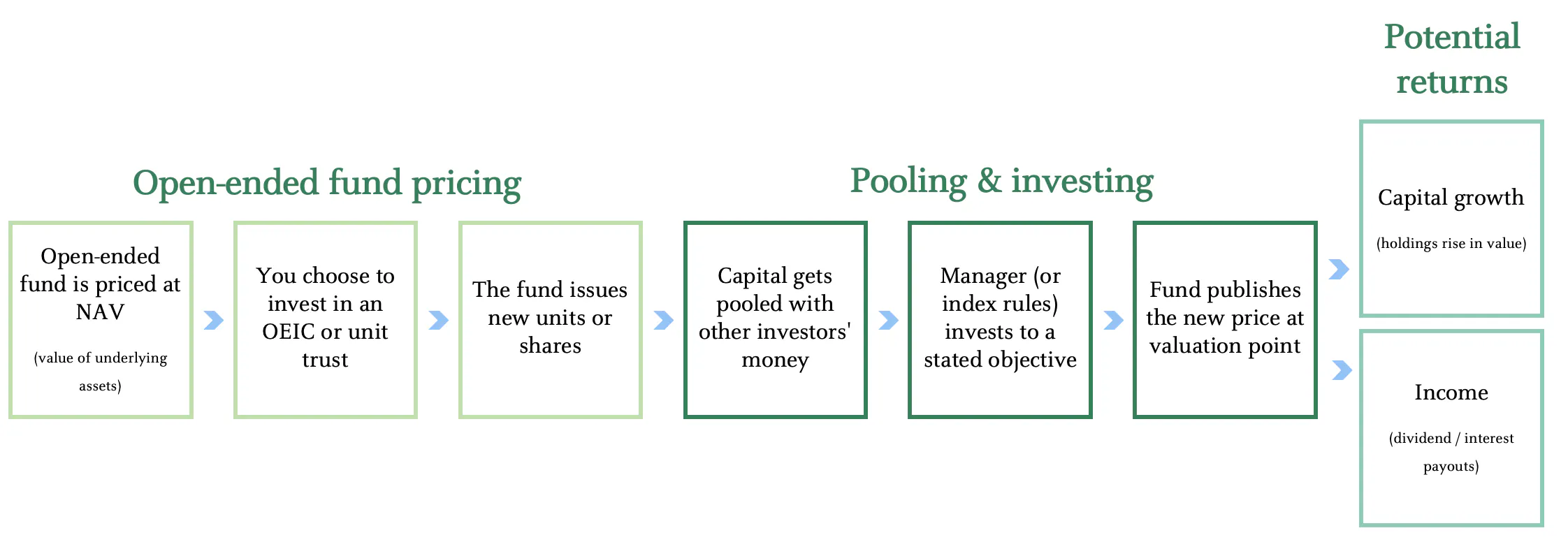
Orders placed by investors are processed at a scheduled dealing time, often called the valuation point. The price that you receive is based on the fund’s Net Asset Value (NAV), which reflects the value of the underlying portfolio rather than being set by the supply and demand forces of the stock exchange.

The key point for investors to know is that this ‘forward pricing’ structure means that while you can see the most recently published NAV, the final price of your order is calculated at the next valuation point. So, the investor does not know the exact price that they will pay eventually when the order is executed. For most funds this price determination is performed on a daily basis. The same process applies when you redeem (sell) your units or shares.
Operationally, it tends to work like this:
- You place an instruction to invest often via a platform or account.
- At the valuation point, the fund calculates the dealing price and issues units or shares to reflect your investment.
- The fund manager invests the pooled money in line with the fund’s objective.
- When you sell, units or shares are cancelled by the fund manager (typically requiring underlying assets to be sold) and the fund pays out the proceeds based on the dealing price.
In periods of market stress (where there is a lot of uncertainty and prices are moving around sharply), some funds may also use liquidity management tools such as pricing adjustments, or in exceptional circumstances, dealing restrictions, to reflect the cost of buying/selling underlying assets and help protect remaining investors.
Note: Returns aren’t guaranteed.
What are the costs involved?
Management and ongoing costs:
- Ongoing Charges Figure (OCF): a published figure intended to capture the fund’s ongoing running costs (including management and administration). It is typically reflected in fund performance rather than billed to you as a separate line item.
- Portfolio transaction costs: costs that can arise when the manager buys or sells the fund’s underlying investments. These can affect returns even though they are not always captured within a single headline charge. This means that these charges are reflected in the fund’s unit price / NAV and therefore in its performance, rather than as a separate “fee” line on your statement.
Platform and dealing costs:
- Platform or account charge: a charge applied by the provider where you hold the investment (structure varies by provider and account type).
- Entry or initial charge: some funds may apply an initial charge when you invest, however many share classes or platform arrangements do not. Check before you invest.
- Exit or redemption charge: some funds may apply a charge when you sell, however this is not common for many mainstream retail open-ended funds. Check before you invest.
Risk warning
The longer you stay invested, the more time your money has to grow. Investments go up and down, so at times you could get back less than you invest. With self-managed investing, you make your own investment decisions and are responsible for choosing and monitoring your investments.
This article may reference products and services which J.P. Morgan Personal Investing does not currently offer.