Investment trusts: what are they and how do they work?
Investment trusts are UK closed‑ended funds that trade on the stock market like shares. This guide explains how they work, why the share price can differ from the value of the underlying portfolio (NAV), and what to know about discounts and premiums, gearing and costs.
Authors:
Navisha Joshi | Andrew Lacey
Last updated: 13 November 2026
What are closed-ended funds?
Closed-ended funds have a fixed number of shares* available and any transactions (trading) in these shares have to be carried in the open market. Commonly used in the UK, an investment trust is a closed-ended collective.
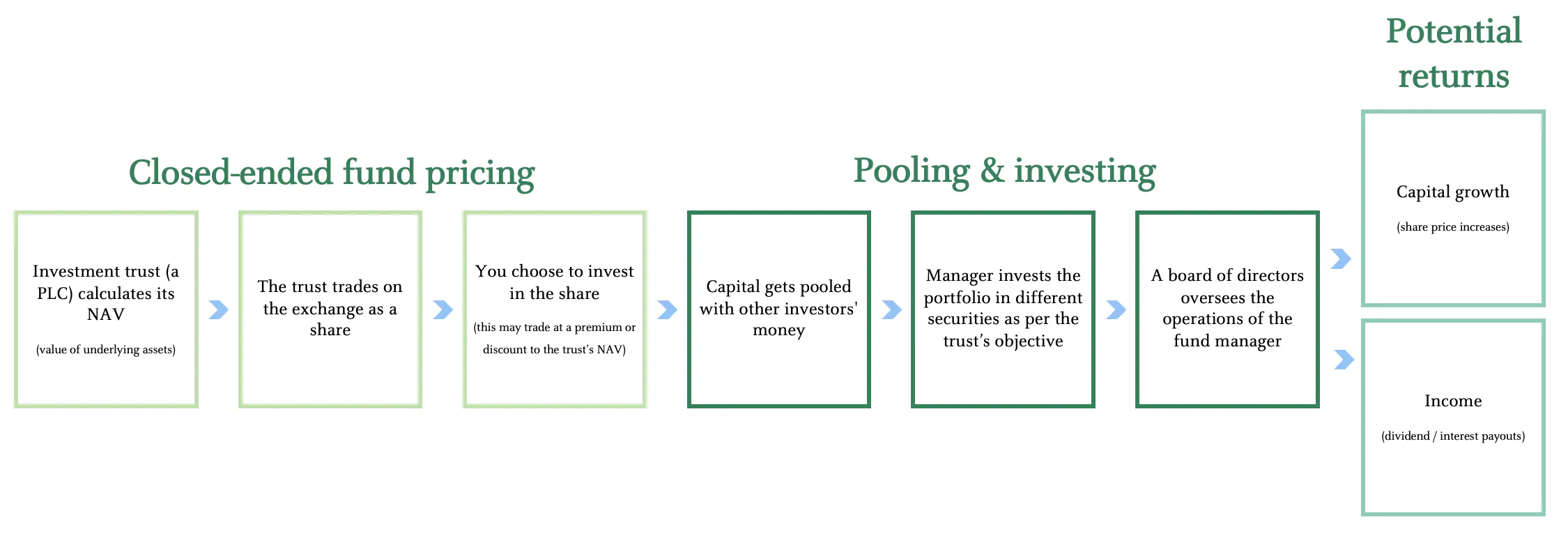
Investment trusts are structured as a listed company (PLC) and investors buy and sell the trust’s shares on the stock market (usually from other investors). The trust’s assets are managed as a pooled portfolio. The trust’s capital is generally stable as it doesn’t have to sell holdings to meet investor withdrawals, hence the amount it has for investing doesn’t change when investors buy or sell shares.
When you invest in an investment trust, you do not choose which holdings to invest in, but instead you are choosing to invest in a trust whose objective, approach and risk profile fits your needs.
The trust runs under a board of directors who oversee the operation of the fund manager(s). It is the board’s role to ensure that the company works in shareholders' interests, for instance, by monitoring performance against the stated objectives, overseeing management decisions or even appointing (or replacing) the fund manager when appropriate. The directors are elected by shareholders to oversee the good governance of the company and look after shareholder interests.
In day-to-day terms, here’s how it works:
- Investors buy and sell shares on the market.
- The investment trust’s share price can move throughout the trading day.
- Because the share price is set by supply and demand, it can be above or below the value of the underlying portfolio (the trust’s NAV), referred to as a premium (above NAV) or discount (below NAV) and usually expressed as a percentage.
*On some occasions, trusts may issue new shares or buy back existing shares, to manage a discount or premium. A buy back results in fewer shares being available in the market, which might in turn increase the fund’s share price.
How are my investments managed?
Similar to other collectives, an investment trust is also managed to meet a stated objective. The investment decisions for the company are made by a professional fund manager (or a management team), which is appointed to run the portfolio within the board of directors' mandate.
As the trust is not forced to meet daily investor inflows and outflows (as with open-ended funds), managers may have greater flexibility to invest over a longer time horizon, including in areas that can be less liquid. However, the exchange-traded structure also introduces additional considerations for investors, such as changes in the discount / premium which can cause deviations from underlying portfolio performance (NAV movements) and impact returns.
How are investment trusts priced?
Investment trusts present the value of their underlying assets as the Net Asset Value (NAV). It is calculated as follows:

However, as investment trusts trade on an exchange, they also have a share price that is based on market supply and demand. The share price and NAV of the fund often tend to be different.
Discounts & premiums
The difference between the trust’s NAV and its share price shows whether it is trading at a premium or a discount:
- Premium: the share price is higher than NAV per share.
- Discount: the share price is lower than NAV per share.
- Par: the share price is roughly equal to NAV per share.
The discount/premium is commonly expressed as a percentage:

For example, a trust with £100 NAV trading at £95 would be calculated as:

Factors such as investor demand and sentiment; recent and future performance; income policy; perceived risk of underlying assets; size and liquidity of the trust; and corporate actions are commonly seen to affect discounts / premiums. For example, if a fund outperforms its benchmark by a good margin, its demand could rise, resulting in a premium. Similarly, if the investors are not optimistic (bearish) on a given sector that the trust is heavily invested in, it might result in trading at a discount.
Often, a trust’s share price can be more volatile than its NAV during periods of market stress or when sentiment changes quickly.
What is gearing?
Gearing (also known as leverage) is borrowing. Some investment trusts borrow money, or use other financing, to invest more than what the shareholders' capital alone would allow. This may help the trust increase its exposure to investment opportunities, which means it can take more risk and invest in areas that are trading at a bargain. Gearing may amplify gains if the trust holdings perform well. However gearing can amplify losses, and increase volatility if the fund holdings perform poorly.
What does gearing mean for me as an investor?
Gearing can make returns less predictable than an otherwise similar ungeared portfolio, however the impact of this depends on how much gearing has been used, the structure (long-term vs flexible) and the cost of borrowing. It is important to note that not all investment trusts use gearing, and it isn’t common with open-ended funds either.
Note: Returns aren’t guaranteed.
What are the costs involved?
Management & ongoing trust-level charges
- Ongoing Charges Figure (OCF): a published figure intended to capture the trust’s ongoing running costs (including management and administration).
- Performance fees: Some trusts may also charge a performance fee which will be set out in the trust’s documentation.
Trading-related costs
As investment trusts trade like shares, investors may face trading costs such as:
- Bid-offer spread (the difference between the buying and selling price in the market)
- Dealing charges (depending on your platform or broker)
- Market-related levies / taxes that may apply to purchases of UK-listed shares (treatment depends on the instrument and venue)
Risk warning
The longer you stay invested, the more time your money has to grow. Investments go up and down, so at times you could get back less than you invest. With self-managed investing, you make your own investment decisions and are responsible for choosing and monitoring your investments.
This article may reference products and services which J.P. Morgan Personal Investing does not currently offer.