What can political uncertainty mean for markets?
8 min

Political events – from elections to shifts in government policy – are a natural part of the economic cycle. Markets can respond to these events, but history shows that they tend to recover after periods of turbulence.
At a glance
- Political events can influence a range of asset classes, including bonds, currencies and equities
- Bond yields may rise and currencies can weaken, while equity prices can fluctuate
- Investors who keep their heads during a crisis, however, can be rewarded by a subsequent recovery
- Markets tend to recover after periods of turbulence demonstrating the importance of spending time in the market, rather than trying to time the market.
Financial markets can react to political change
Election results, changes in political leadership and pivots in fiscal policy are all examples of how politics can impact financial markets. This can be for a number of reasons, such as expectations of rising costs for companies brought about by a new policy, or uncertainty about future fiscal policy and the sustainability of government borrowing.
You will often read in the news about movements in bond yields, falling currencies and sell-offs in equities during periods of turbulence. While it’s a good idea to stay abreast of what’s going on in markets during moments of political uncertainty, it’s important to remember that events can move quickly.
While some downturns can unfold over a sustained period, financial markets can often recover rapidly after a day of decline, so it’s important not to panic during a period of turbulence. Investors who maintain their holdings during periods of volatility are often rewarded for their patience as markets recover.
What happens to bond yields during uncertainty?
Political uncertainty can spark a sell-off across markets. For bonds, this means higher yields, resulting in an increase in the cost of borrowing. The prospect of higher yields can be enticing for some investors.
In this scenario, investors are perceiving government debt as riskier and therefore demand a higher return – the yield – to compensate for doubts over the sustainability of government borrowing or a change in fiscal policy. A spike in borrowing costs can also constrain companies from financing projects and investment, and can also act as a headwind to equity market performance.
During a period where markets are losing confidence, the fixed income portion of a portfolio can lose value as bond yields are driven higher. This is because bond prices and yields move inversely – if new bonds are issued at higher rates, older bonds with lower coupons become less attractive and their prices fall to compensate.
Surging yields can, however, present investors with an opportunity. They can buy bonds offering more attractive income than was available before the instability began. If an investor believes the volatility is temporary, it can be an excellent time to buy bonds.
In March 2026, gilt yields jumped after the conflict between Iran and the US pushed up oil prices, stoking inflation fears. But as yields reached historically attractive levels, buyers returned to the market and gilt prices rebounded in May.
While we advocate spending time in the market over trying to time the market, it’s true that investors who bought gilts during the sell-off locked in higher yields than had been available just weeks before.
“Bond markets are influenced by many factors, but principally expectations around inflation, economic growth, central bank policy and fiscal policy (net government spending),” says Investment Strategist Scott Gardner.
“We regularly review our fixed income allocations, tilting our portfolios to take advantage of opportunities or minimise risk,” he continues.
How might currencies respond to political upheaval?
Political instability can also negatively impact the value of a domestic currency. Investors may lose confidence and reduce their holdings in a currency. Conversely, currencies can soar when confidence returns to markets.
A falling currency increases the costs of imports, which can also push up inflation. This may further undermine investor confidence and could incentivise more selling of the currency.
As the Iran war unfolded in March 2026, sterling fell sharply and posted its worst monthly performance against the dollar since October 2025. It was, however, the best-performing major currency against the dollar, as markets began to predict more interest rate hikes in the UK compared to the US – which can make the currency more attractive to hold.
If the pound weakens, the value of some equities may rise – particularly those companies that derive more earnings overseas, which stand to benefit from a fall in the pound after they convert their foreign earnings into pounds. The FTSE 100 – an index of the 100 largest companies listed on the London Stock Exchange – generates a sizeable proportion of its earnings overseas, and can therefore benefit from a falling sterling.
“We don’t actively trade currencies short-term and take a risk management approach that considers changes in expectations around differences in interest rates, inflation and growth rates,” says Gardner.
How equities react - and recover
A loss of confidence in equities can result in a market sell-off. Political instability and the prospect of a change in policy, such as higher taxes, can hamper business confidence and a company’s ability to make decisions.
Some sectors are more exposed to political risk than others. For example, oil and gas companies can be particularly sensitive to changes in policy and regulation, such as the introduction of windfall taxes, which are sometimes levied by governments on profits that are deemed to be attributed to external economic conditions.
A portfolio that has a heavy domestic bias in its equity allocation can be more heavily impacted by political instability (if limited to one country) than a portfolio with an internationally diversified equity allocation. As mentioned above, a depreciating currency could increase the value of overseas equities in a portfolio.
Should a crisis spread beyond borders – for example, the coronavirus pandemic – investors can still expect a negative impact in a portfolio that is geographically diverse. While markets fell in the early days of the pandemic, they recovered rapidly, which shows that even the biggest shocks can be followed by a market rally.
Rising bond yields can also affect how equities are valued. A company’s share price represents the present value of expected future cash flows, discounted back at a rate that reflects the time value of money and risk.
Government bond yields are a key component of this discount rate. If yields rise, the discount rate applied to future corporate earnings also increases, which lowers the present value of those earnings and therefore the value of the share price. Higher bond yields can also make bonds more attractive to investors than equities, which can lead to a sell-off.
Global equity markets experienced a downturn in early 2026 over fears about the disruption that artificial intelligence models could pose to businesses, followed by the Iran conflict. But equities quickly rebounded. In fact, global equity funds received $31.26 billion in inflows in mid-April – the highest weekly inflow since March 2025. Globally-diversified investors who maintained their holdings during the year’s turbulence were rewarded as indices such as the S&P 500 – an index that comprises 500 of the largest listed companies in the US – reached record highs.
The FTSE 100 and the S&P 500 have recovered from turbulence in recent years and delivered long-term growth
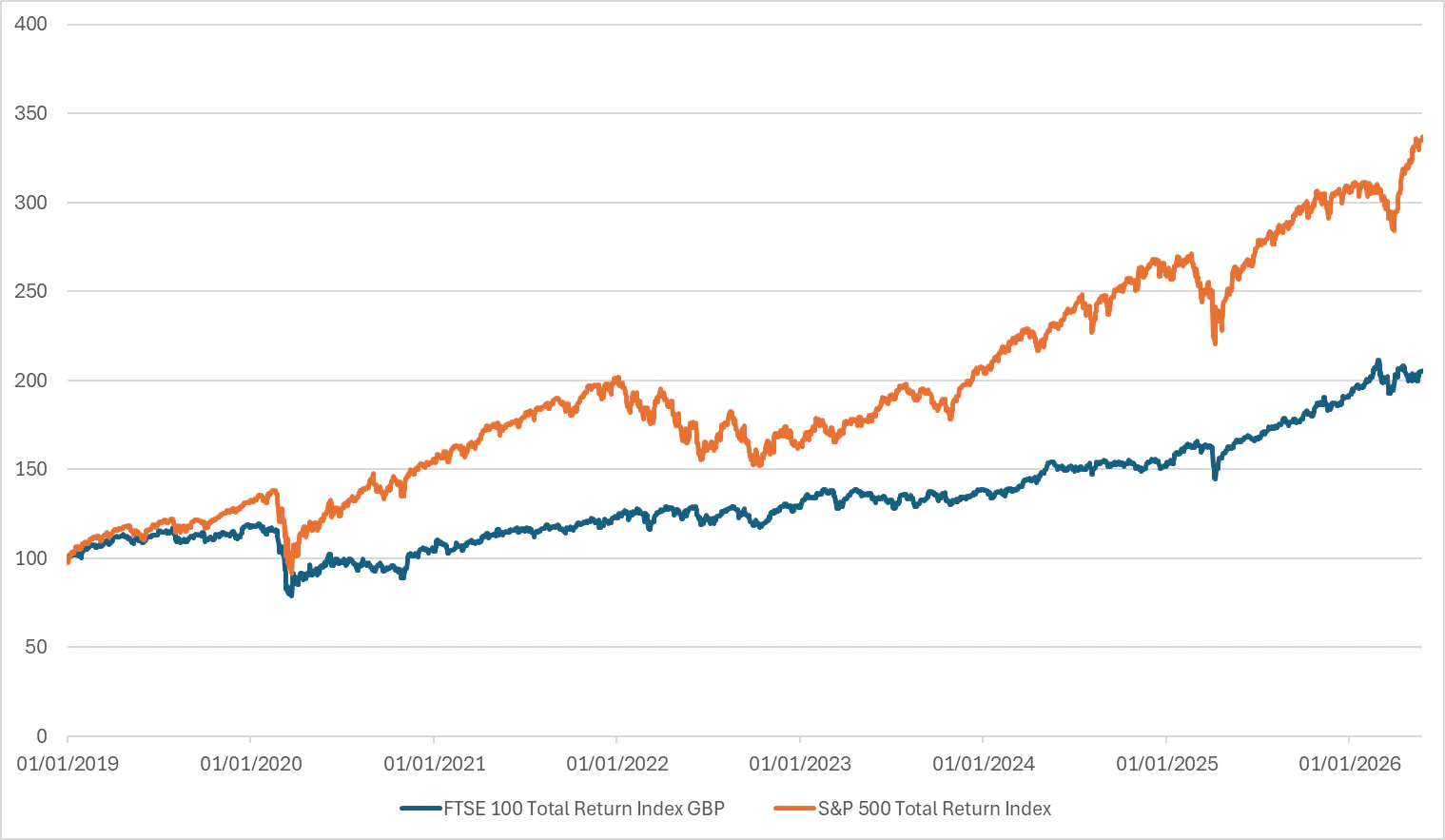
Source: Bloomberg. Index performance rebased to 100 as at start of timeline. These figures refer to past performance, which isn’t a reliable indicator of future performance. Data as at 26 May 2026.
“We take a proactive approach to analysing equity markets, looking at expectations around earnings growth, as well as valuations and the impact of the wider economic and policy environment,” says Gardner.
How J.P. Morgan Personal Investing manages portfolio risk
We understand that our clients might have concerns about the impact of political instability on their portfolios and want to know how we manage portfolio risk.
When investments lose value, it’s worth remembering that a loss is only realised when an investment is sold. Although an investor may see their portfolio value move around more quickly than normal during a period of heightened market volatility, that same portfolio may not be down in value in a month’s time, or by the end of the year, for example. We advocate time in the market instead of trying to time the market, in part to benefit from compounding.
Our investment experts closely monitor and analyse financial market data, economic data, and developments in the global policy landscape that can impact investments. This involves daily risk monitoring, ensuring that portfolios are well-diversified across asset classes and investing in exchange-traded funds that have been rigorously researched and selected to meet our standards for size, trading volume, and liquidity.
We make tactical changes to your portfolio's mix of investments, in a process known as ‘rebalancing’. Our Fixed Allocation portfolios are reviewed annually, while the rest of our portfolios are rebalanced more regularly as and when the team believes it is most appropriate.
We understand that appetite for risk can be highly personal. At J.P. Morgan Personal Investing we aim to understand your tolerance for risk, and ensure your portfolio is invested appropriately. If your financial circumstances have changed and you would like to discuss your portfolio with our team, please book a call for free financial guidance.
Risk warning
As with all investing, your capital is at risk. The value of your portfolio can go down or up and you may get back less than you invest. Past performance and forecasts are not reliable indicators of future performance. We do not provide investment advice in this article. Always do your own research.