How to teach your child about their Junior ISA
8 min

The thought of young adults taking control of large sums of money from their Junior ISA may concern some parents, but there are ways to educate your child to put them in a good position to make the most of their windfall.
At a glance
- The Stocks and Shares Junior ISA (JISA) is a tax-efficient way for parents to invest on behalf of their children without using up their own annual tax allowance.
- Children cannot usually access the money until they turn 18, when the account becomes theirs to control.
- Parents can start money conversations early, using simple lessons about spending, saving and choices.
- As children get older, parents can introduce the difference between cash saving and investing.
- Before the child turns 18, it can be sensible to agree a rough plan and check the transfer process with the JISA provider.
What’s a Junior ISA?
A Stocks and Shares JISA lets you manage investments on behalf of a child until they're 18. Any income or capital gains generated within the account are protected from UK Income Tax and Capital Gains Tax, subject to ISA rules. You can invest up to £9,000 each tax year in a JISA per child. Crucially, this figure does not form part of your standard annual ISA allowance of £20,000.
Children cannot access their Stocks and Shares JISA until the age of 18, while parents or legal guardians cannot typically withdraw these funds at any point. At this point, it will convert into a Stocks and Shares ISA and be under the 18-year-old’s control.
Parents or legal guardians can also open a Cash JISA for a child, which is a tax-efficient savings account for children under 18, although we do not offer Cash JISAs. A child can have only one Cash JISA and one Stocks and Shares JISA, while the annual £9,000 is spread across both products. If you have multiple children, you can open a Cash JISA and a Stocks and Shares JISA for each of them.
The Junior ISA handover is becoming even more important
Parents are increasingly taking action to invest on behalf of their children. In 2025 alone, J.P. Morgan Personal Investing observed a 20% increase in the number of JISA accounts held with us.
The number of children who will be able to access large sums of money on their 18th birthday is surging. According to data obtained by J.P. Morgan Personal Investing via a Freedom of Information request, the number of JISAs holding at least £10,000 more than doubled between the 2019-20 and 2023-24 tax years. The number of accounts holding five-figure sums rose from 124,000 to 294,500.
The thought of your children taking control of large sums of money at the age of 18 may make you feel uneasy, but there are steps that you can take to help your child make sensible decisions with their savings. Start talking to your child about money when they’re young and tell them about their JISA years before they take control of it.
“While some parents may fear this moment when the money is transferred, it’s important to see this as a real opportunity to have a practical conversation with your child about budgeting, saving and investing,” says Charlotte Wheeler, Senior Wealth Manager at J.P. Morgan Personal Investing.
Ages 4 to 7: make money visible and simple
The concept of investing is likely to be beyond the understanding of most children below the age of seven, but it’s still possible to build a basic awareness of money at this life stage.
Young children can typically understand that money can be saved or spent, and that some things cost more than others. Use pocket money to explain the difference between spending now and saving for later.
You could even introduce the idea that you are saving money for them for when they’re older.
Ages 8 to 11: introduce goals and delayed gratification
From the age of eight, you can try to help your children connect the idea of saving with future choices.
You could explain that saving regularly typically helps to build the value of their savings pot. Talk about how bigger goals, such as a holiday or buying a new house, can take longer to save for, and that decisions surrounding money involve trade-offs.
At this age, you can attempt to introduce the JISA as a pot of money that is being built for their future. You don’t necessarily need to name the product or talk about investment returns, but you can use the conversation to discuss how regularly putting money into the pot helps to grow it over months and years.
Ages 12 to 14: explain saving versus investing
There’s no need to rush into a detailed explanation of how investing works, but it could be worth introducing the basics to your child as they head into their teenage years. You can use this opportunity to explain the difference between cash saving and investing.
The box below can also help to summarise the differences between saving and investing.
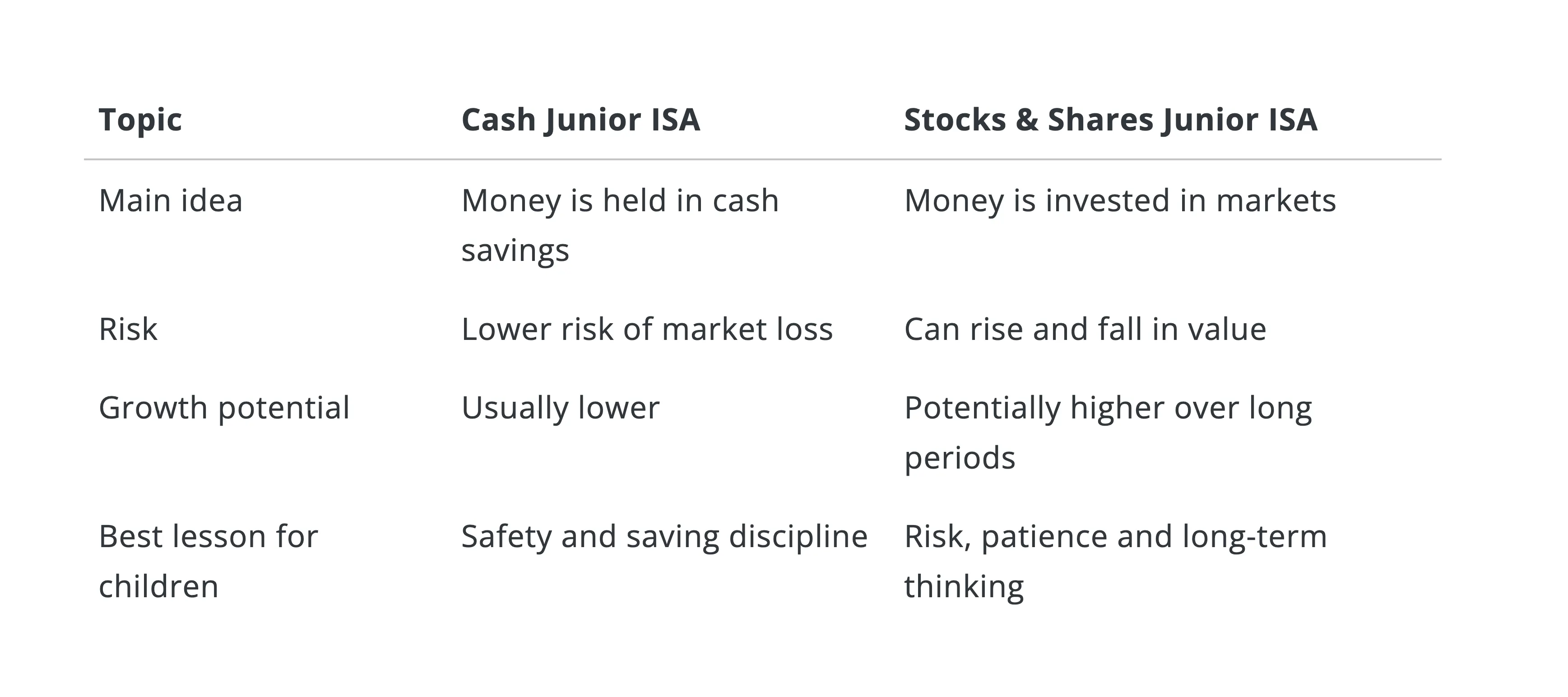
You can talk about how cash savings are typically more stable, but add that they tend to grow slowly, while you could also potentially introduce the concept of inflation and its impact on cash over the long term. Explain that investments have the potential to grow more over time, but they can also rise and fall in value. It’s worth pointing out that cash and investments work together, and are not mutually exclusive.
It can be helpful to frame this conversation with the concepts of risk and reward. Connect the two and explain how time in the market can give investments more opportunity to recover from periods of volatility, although this is not guaranteed. Avoid explaining investing as a guaranteed way to become wealthy, and be honest about investment risk.
Explain how regular investing can work, while making clear that investments can fall as well as rise and may not be suitable for every goal. Our analysis shows that £100 per month invested in a global tracker over 10 years would have grown to around £23,830, compared with around £13,900 in a cash savings account tracking the Bank of England base rate. Use a simple line chart to demonstrate this.
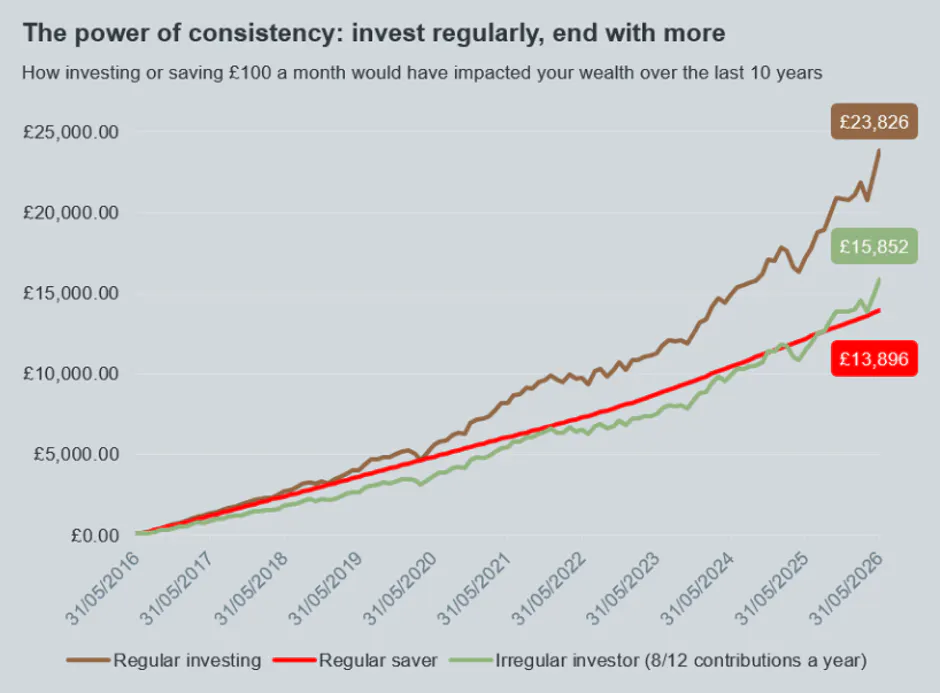
Source: J.P. Morgan Personal Investing. Chart shows 10-year historic comparison of how £100 monthly contributions performed over time depending on behaviour: investing monthly in a global tracker (Regular investing), saving monthly in cash tracking the Bank of England base rate (Regular saver), and investing irregularly by missing four monthly investments each year (Irregular investor). Past performance isn’t a reliable indicator of future performance. Calculations reflect nominal value (before inflation). No trading or platform costs included. ACWI management fee factored into account via Net Asset Value.
Ages 15 to 17: begin the real handover conversation
With only a handful of years until your child can access their JISA, now is the time to have a serious conversation about their money.
Explain what the JISA is and how the money came about. Confirm that their account will convert into an ISA and provide a light summary of how ISAs work. Introduce the concept of compounding and explain how investing for longer typically results in better returns than investing irregularly or cash saving.
You may wish to explain the story behind the money to your child. It could be helpful to emphasise that the money was built up over many years with the intention of giving them the ability to make more choices as an adult. You might want to explain the hopes you had when building the JISA, while recognising that the money will be theirs to manage. Rather than focusing on what they should not do, encourage them to think about how different choices could affect their future options.
Try to remain positive in the conversation. Ask your child what they would like to do with the money and discuss its possible uses, such as education, travel, buying a home, or investing. You can help them create different time buckets, such as below:
Short-term: spend the money on travelling for a month once they turn 18
Medium-term: fund education or training
Long-term: invest towards buying their first home
It could be worth taking the time to help them learn about how our JISAs invest, or even speaking to one of our wealth experts for free to discuss your child’s options. It’s also a good idea to check with your provider what documentation you’ll need for the transfer to be completed.
Age 18: what to do when the transfer takes place
With your child now in control of the money, be available to support them on how to use it. Offer help without appearing controlling. Put yourself in their shoes.
Example questions that parents can ask:
- “What would you like this money to help you achieve?”
- “How much would you like to keep for later?”
- “Would it help to speak to someone independent?”
It may also be useful to talk about some of the common mistakes that adults make when managing money. This includes spending too quickly, taking investment tips from social media, and withdrawing funds without thinking about future objectives.
Remind them that they do not need to make every decision immediately. Taking time to understand their options can help them avoid rushed choices.
“Parents should lean into these financial conversations, helping their kids understand the options available and how to best use the money in their JISA,” says Wheeler.
“Taking control of a large sum can feel daunting for a young adult who hasn’t managed that level of money before. Parents can help take that weight off their child’s back by engaging early, building their confidence, and helping them make good financial decisions.”
Speak to our wealth experts
Our wealth experts can help you to explore how to invest consistently while ensuring that you have enough cash to cover your expenses. You can book a call to speak to one of our experts for free.
If you would like a personalised financial plan, we also have paid financial advice where we will review your finances and goals to help you build a financial plan with our recommended approach for you.
Risk warning
The longer you stay invested, the more time your money has to grow. Investments go up and down, so at times you could get back less than you invest. To open our JISA, the child must be under 16 and funds can't be withdrawn until they turn 18. Tax rules vary by individual status and may change. We provide 'restricted advice', meaning we only make investment recommendations on the managed products and services that we offer.