Will your midlife savings match your midlife ambitions?

Alex Janiaud
7 min

People entering their thirties are increasingly viewing their next few decades as a window of opportunity, growth and reinvention. Building good financial habits and investing regularly could help you achieve some of your life goals.
A new J.P. Morgan Personal Investing survey* found that as many as 60% of people aged 30 to 60 see the midlife period – the years spanning 40 to 60 – as a chance to reinvent themselves.
But despite plans for life-changing travel, a career change or studying for new qualifications topping lists of life goals, half of those in midlife regret not planning more when they were younger to fund these ambitions.
‘Rewrite the script in your forties and fifties’
Among people in their thirties surveyed, going on a once-in-a-lifetime holiday ranked top in terms of midlife ambitions, following by paying off a mortgage earlier and increasing their pension contributions.
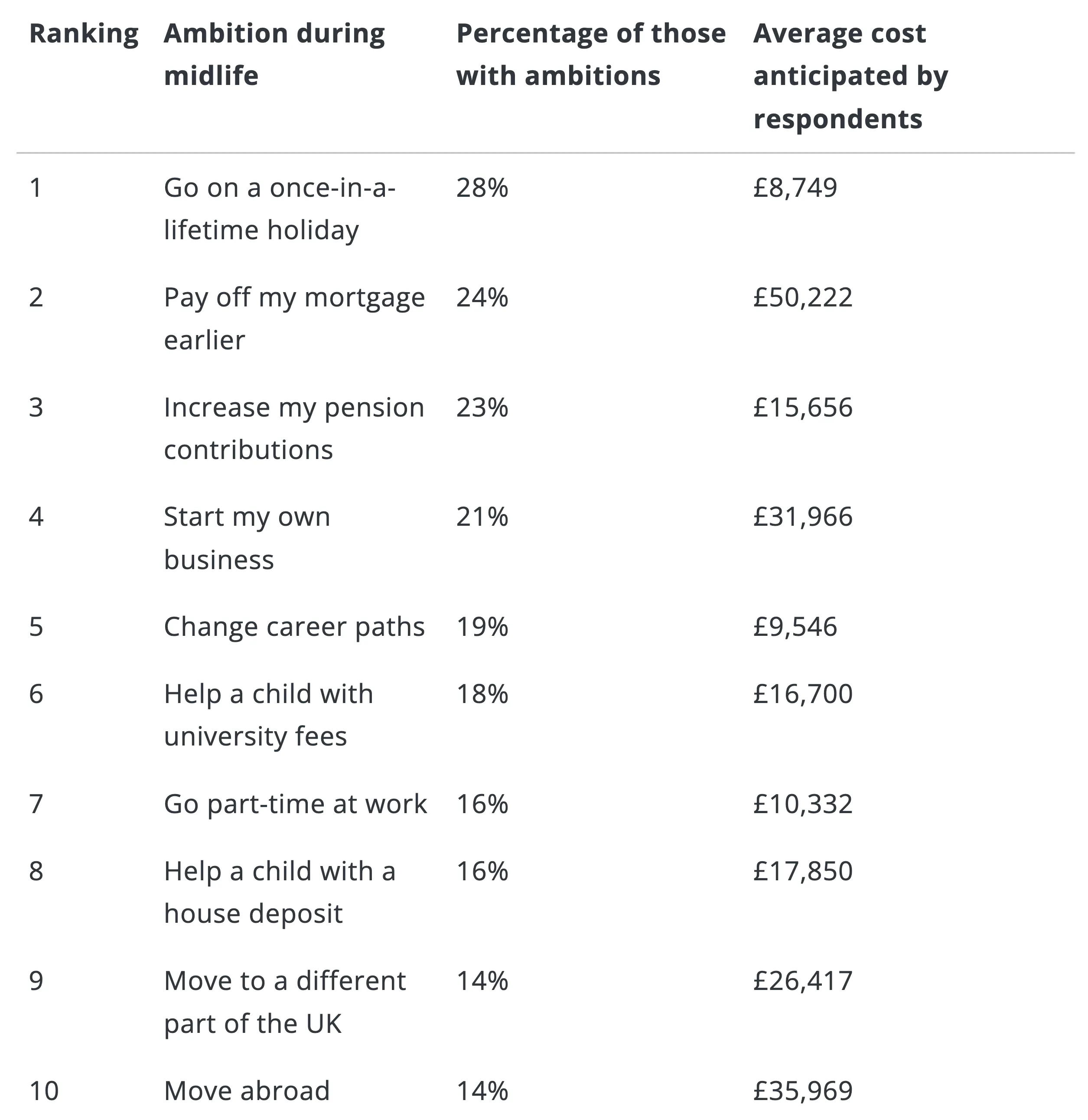
Source: Opinium survey: ambitions of people in their thirties for their midlife and their expected expenditures.
“Midlife today has moved beyond the perception of ‘crisis’, it’s a period of reinvention and choice for UK adults,” says Claire Exley, Head of Financial Advice and Guidance at J.P. Morgan Personal Investing.
“People are using their forties and fifties to rewrite the script - changing careers, starting businesses, taking once‑in‑a‑lifetime trips and finally carving out time for themselves.”
While people want to achieve some goals and do more with their midlife years, our study showed that few people are planning for this period.
The majority of people in their midlife we surveyed (51%) wished that they had started planning financially earlier. Over a third (38%) of those in their midlife said they had a rough plan for this period of life, while only 9% said they had planned financially for their goals. As a result, some people may find that their ambitions for midlife are out of reach.
How to fund a midlife ambition
When building a financial plan for the future, it can pay to take a broader view and consider how your choices align with your goals. It’s worth considering what goals you might have and when you might need the money to fulfil them. Once you have answered these questions, you can start thinking about whether you should save or invest towards your goals.
If you’ve decided that investing is right for you, it’s usually a good idea beforehand to think about building a cash buffer that you can use to cover unforeseen expenses and short-term spending needs.
Your personal circumstances will dictate the amount of emergency cash that you might need. We typically recommend having an emergency cash fund to cover three to six months’ essential expenses in an easy-access account, plus enough to cover any major planned expenses such as home repairs or a car replacement in the next two to three years.
It’s important, however, not to have too much kept in cash. Many adults in the UK hold excessive amounts of cash instead of investing, which can leave savings vulnerable to the impact of inflation and see people miss out on potentially higher returns generated by putting their money to work in financial markets. However, with investing it’s worth remembering that your returns can go down or up, and that you may lose money.
“Once you have identified how much you can put away each month, setting up a direct debit for monthly contributions can help you automate your savings and build good financial habits,” says Charlotte Wheeler, Senior Wealth Manager and Chartered Financial Planner at J.P. Morgan Personal Investing.
If your midlife goal is over three years away, you could consider investing towards this goal by investing regularly. By consistently using your ISA allowance throughout each tax year, you could build up a sizeable pot of money and benefit from tax-free growth and returns, Wheeler says. You have an ISA allowance of £20,000 per tax year.
“Making monthly contributions into your Stocks & Shares ISA has the additional benefit of drip-feeding money into financial markets which can help smooth out any periods of volatility”, she adds.
Even a moderate level of investing would support a healthy contribution towards funding some of the midlife ambitions identified through our survey. A monthly investment of £50 throughout your thirties, assuming a 5% rate of return, would yield £7,764.11 by the end of the decade. This calculation is purely illustrative and does not include fees or reflect the impact of inflation.
Figuring out how much cash you need and how much you can afford to invest can be challenging, and will likely be subject to change. You can use the Money and Pensions Service’s budget planning tool to help measure your income and spending.
Our wealth experts, meanwhile, can help you explore how you could invest more tax-efficiently while making the most of your annual allowances. You can book a call to speak to one of our experts for free.
Make sure to fund your retirement properly
With increasing pension contributions ranking high among the midlife spending ambitions identified by our survey, it pays to think about saving for your latter years too, particularly as retirement draws closer. Many people in their midlife years will speak with an expert for guidance or advice in order to see if they are on track for a good quality of retirement, or whether they need to change their retirement planning strategy.
If you're retiring in the next few years, it’s useful to work out what your annual expenditure may be, along with any big outlays on purchases like cars or renovations, and consider having cash available for this period.
As a guide, the Pensions UK/Loughborough University Retirement Living Standards estimate that a one-person household will need to spend £43,900 annually to enjoy a comfortable retirement – one that includes financial freedom and some luxuries. This threshold rises to £60,600 per year for a two-person household. It is likely that you will have some retirement income in the form of a workplace pension, as well as the state pension, but it can be a good idea to put cash aside to supplement this money.
The death of a spouse might reduce pension income from workplace pensions or state pensions. J.P. Morgan Personal Investing wealth experts stress-test this scenario for their clients, and it’s worth considering a possible reduction in retirement income when trying to forecast how much money you’ll need towards the end of your life.
Wheeler says that there isn’t a one-size-fits-all approach to figuring out how much to contribute into a pension. “Your thirties are a great time to review your retirement savings and ensure you are making adequate pension contributions to ensure a quality of living in retirement that aligns with your goals,” she says.
“To work out how much you should be contributing, start by working out your retirement goals, the age you want to retire, and the lifestyle you want,” she continues. “Then, review your current pension set-up with your pension provider.”
Questions to ask yourself include:
- Are you maximising what you can afford to contribute to your pension to benefit from tax relief and any employer matching?
- Could you increase your pension contributions and reduce your annual tax bill?
- Are your pension savings invested correctly?
“This last question is often overlooked as many don’t review their investment strategy to ensure their retirement savings align with their risk tolerance,” says Wheeler.
“It’s worthwhile considering the potential benefits of consolidating old pensions, which can make it easier to manage your savings, reduce fees, and ensure your investments are working efficiently for you,” she adds.
Risk warning
As with all investing, your capital is at risk. The value of your portfolio can go down or up and you may get back less than you invest. Tax rules vary by individual status and may change. Before transferring your pension, check you won't lose any benefits or pay any unexpected charges. During a transfer, your investments will be out of the market. Seek financial advice if you're unsure if a transfer is right for you.
*Opinium survey of 2,000 UK adults aged 30-39 and 2,000 UK adults aged 40-60 undertaken from the 20th - 27th February 2026. Opinium Research is a member of the British Polling Council and abides by its rules. ‘Midlifers’ defined as older survey cohort, between 40-60 years of age.