Cash ISAs are useful. But are they right for retirement?
8 min

Cash is a vital part of financial planning, and a Cash ISA can be a valuable savings tool. But it's important to know when cash provides security, and when it may hamper your retirement strategy.
At a glance
- Cash ISAs are one of the UK’s most widely used savings products, with 14.4 million people holding a Cash ISA and no other type of ISA, according to a House of Commons committee report¹.
- Per the Investment Association trade body², 32% of Cash ISA holders are using them to save for retirement. That includes 48% of Gen X Cash ISA holders and almost one in five Gen Z Cash ISA holders.
- Cash can help with emergency savings and short-term goals, but inflation can reduce its spending power over time.
- Pensions and Stocks and Shares ISAs may be more suitable for long-term retirement goals, depending on your circumstances.
- Our wealth experts can help you understand how your cash, ISAs and pensions could work together.
Cash ISAs can play a helpful role
It’s a good idea to have a cash buffer to meet both planned and unplanned spending needs. A Cash ISA is one place that you can hold cash tax-efficiently and can be a sensible home for:
- Emergency savings
- Short-term goals
- Money you may need in the next few years
- Savers who cannot or do not want to take investment risk
- People in later life who need stability and access.
You can currently contribute up to £20,000 per tax year into a Cash ISA as part of your overall annual ISA allowance of £20,000, and earn interest on your money without paying tax on it. From 6 April 2027, this will be reduced to £12,000 for those aged under 65. The government plans to introduce a new 22% charge on cash held in non-Cash ISAs, to stop people using these products to circumvent the new rules.
This means that if you were under the age of 65 and placed £12,000 in a Cash ISA, the maximum that you’d be able to invest in a Stocks and Shares ISA in the same tax year would be £8,000. Please note that J.P. Morgan Personal Investing does not offer Cash ISAs.
Cash ISAs are popular with savers. A House of Commons committee report published in October 2025 noted that Cash ISAs are the most widely used type of ISA, with 66% of ISA subscriptions directed to Cash ISAs in the 2023–24 tax year. It also found that 14.4 million people hold a Cash ISA and no other type of ISA.
A separate publication by HMRC in July 2026 revealed that the number of people making individual contributions to a personal pension fell to 6.4 million in the 2024 to 2025 period from 6.8 million across 2023 to 2024.
A significant proportion of Cash ISA holders are using the product to save for retirement. While this might be suitable for some savers, particularly if they are very close to retiring and don’t want their savings exposed to movements in financial markets, it may not always be the right vehicle for building a retirement fund.
If you want to keep some money in cash without using your ISA allowance, a standard savings account may also form part of your wider plan. Chase, which is also a part of JPMorganChase, offers a savings account that earns interest³ that could help you manage cash separately from your long-term ISA and pension savings.
Keeping too much of your savings in cash can come at a cost
According to the Investment Association’s 2026 ISA Barometer, 32% of Cash ISA holders are using the product to save for retirement.
That includes:
- 48% of Gen X (aged 46-61)
- 28% of Millennials (aged 30-45)
- 26% of Baby Boomers (aged 62-80)
- 19% of Gen Z (aged 18-29)
Allocating too much of your savings to cash leaves you exposed to the effect of inflation, particularly if the interest on your cash does not keep pace with price increases. The below chart demonstrates the impact of inflation on purchasing power, which diminishes steadily over time.
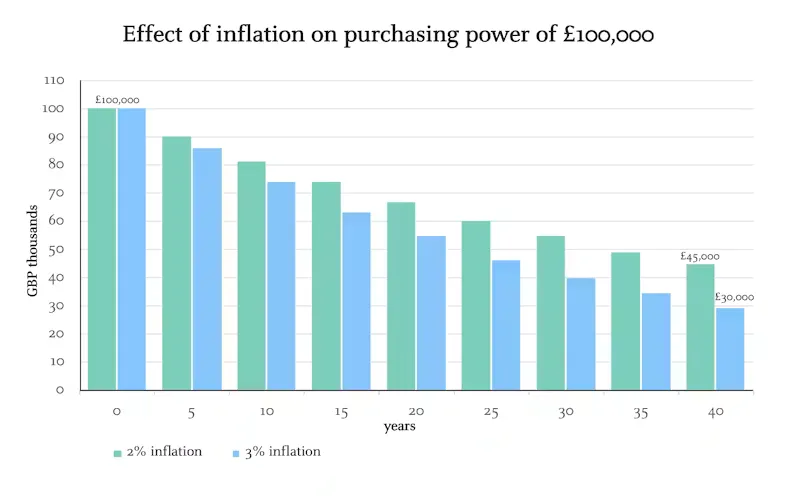
Source: J.P. Morgan Asset Management. For illustrative purposes only, assumes no return on cash. Past performance is not a reliable indicator of current and future results. Guide to the Markets – UK. Data as of 31 December 2025.
Investments do not always outperform cash and past performance is not a reliable indicator of future performance. But putting your money to work in financial markets is generally more likely to build wealth than keeping it in cash.
Spending a long time in cash can affect investors across age categories. The consequences of spending potentially 40 years in cash for Gen Z savers could make it harder to save for a comfortable retirement. Even some Gen X savers surveyed by the Investment Association could be a couple of decades away from retiring, which is also a long time to spend outside the markets.
In an environment of low interest rates, your cash savings rate is unlikely to be particularly high. In this scenario, allocating too much of your money towards cash may also mean that you see minimal returns compared with investing via a Stocks & Shares ISA or a pension, for example.
ISA or pension: which is right for retirement?
A Cash ISA, Stocks and Shares ISA and pension can all play roles in financial planning. But they are designed for different jobs.
Cash ISA
A Cash ISA may be useful for:
- Emergency savings
- Short-term goals
- Money you may need soon
- Savers who want certainty rather than investment risk
- Savers who want to receive regular interest on their cash.
It is familiar and tax-efficient, but it does not give your money exposure to financial markets.
Stocks and Shares ISA
A Stocks and Shares ISA may be useful for:
- Medium and long-term goals
- Money you do not expect to need for at least five years
- Tax-efficient investing
- Flexibility, because money can be accessed before retirement⁴.
Unlike a Cash ISA, your money is invested. That means it has the potential to grow, but it can also fall in value.
Pension
A pension may be useful for:
- Retirement-specific saving
- Long-term investing
- Making use of pension tax relief
- Building a pot designed to provide income later in life.
The trade-off is that pension money is usually locked away until your minimum pension access age. This is currently 55, but will rise to 57 in April 2028.
For many people, the right answer may not be one product. It will likely be a combination of multiple products.
With the Cash ISA annual allowance set to fall to £12,000 for people under the age of 65 from April 2027, now may be a sensible time to review how you’re building your cash buffer and the extent to which you want to use a Cash ISA to save for retirement.
How to review your retirement savings
If you are using a Cash ISA for retirement, it may be worth reviewing your wider plan.
You could start with six questions.
1. What is each pot of money for?
Separate your money into buckets for short-term, medium-term and long-term goals.
Emergency savings are different from retirement savings. Money for a house deposit is different from money for later life.
2. How much cash do you really need?
We normally think it is sensible to keep enough easy-access cash to cover three to six months’ essential expenses.
Some people will need more. Others may be comfortable with less. But once you have a suitable cash buffer, it may be worth asking whether additional long-term cash could be invested.
3. How long until you need the money?
Money you need in the next year should usually be treated differently from money you do not need for 10 or 20 years.
The longer your time horizon, the more time you may have to ride out market ups and downs.
4. How much investment risk can you accept?
Investing is not necessarily right for everyone. But avoiding all investment risk can create another kind of risk: the risk that inflation reduces the spending power of your retirement savings.
The goal is not to take as much risk as possible. It is to take a level of risk that fits your goals, time horizon and comfort.
5. Are you making enough use of your pension?
For retirement saving, pensions can be powerful because they are designed specifically for that purpose.
Depending on your circumstances, pension contributions may benefit from tax relief and, for workplace pensions, employer contributions.
6. Would advice help?
If you are unsure how to balance cash, ISAs and pensions, paid financial advice could help you build a personalised plan.
This can be particularly useful if retirement is getting closer, your finances are more complex, or you want help understanding how much you may need.
Our wealth experts can help
Our wealth experts can help you explore how your cash savings, ISAs and pensions could work together as part of a retirement plan. You can book a call to speak to one of our experts for free.
If you would like a personalised financial plan, we also have paid financial advice where we will review your finances and goals to help you build a financial plan with our recommended approach for you, based on our products and services.
Depending on your needs, that could mean:
If you are asking… | J.P. Morgan Personal Investing can help you… |
|---|---|
“How much cash should I keep?” | Think about your emergency fund and short-term needs |
“Should I invest some of my ISA money?” | Understand whether a Stocks and Shares ISA could suit your goals |
“Am I saving enough for retirement?” | Review how pensions and ISAs could work together |
“I’m nervous about risk” | Understand investment risk in plain English |
“I want a plan” | Explore paid financial advice for personalised recommendations |
Risk warning
The longer you stay invested, the more time your money has to grow. Investments go up and down, so at times you could get back less than you invest. Product and eligibility rules apply.
Tax rules vary by individual status and may change. J.P. Morgan Personal Investing does not provide tax advice. For personalised advice tailored to your specific situation please consult with a qualified tax adviser or financial planner. We provide 'restricted advice', which means we will only make investment recommendations on the products and services that we offer.
If you are unsure if a pension is right for you, please seek financial advice.
Past performance and forecasts are not a reliable indicator of future performance. We do not provide investment advice in this article. Always do your own research.
¹Cash Individual Savings Account, House of Commons Treasury Committee, 25 October 2025
²ISA Barometer 2026: ISAs as a gateway to investing, Investment Association, June 2026
³For Chase savings account: 18+, UK residents. Chase current account required - eligibility applies. Investments not guaranteed by Chase or JPMorgan Chase Bank, N.A.
⁴Depending on what kind of ISA you have, your annual tax allowances may not replenish when you withdraw your money. The current annual tax-free allowance for investing in a Stocks and Shares ISA, for example, is £20,000. If you withdrew £5,000, for example, from your J.P. Morgan Personal Investing ISA and subsequently changed your mind, you would not regain any portion of your annual tax-free allowance if you put your money back in, so you would have ‘lost’ the tax relief on that £5,000.