What is a bond?
A bond is generally a loan you make to a government or company, in exchange for regular interest payments and the return of your money at a set date. This guide explains how bonds work, the main types, and the risks investors should understand before investing.
Authors:
Last updated: 13 August 2026
Guide to bonds
This guide explains bonds in simple language, breaking down how they work and how investors can use them in their portfolio, while outlining the potential benefits and risks involved.
- How bonds work – We explain what investors mean when they say 'yield', 'par value', 'coupon', 'maturity date' as well as other important terms
- Types of bonds – This section digs deeper into the bond market, explaining the differences between government and corporate bonds, and what bond ratings mean
- The role of bonds in a portfolio – A look at the potential benefits of adding bonds to a portfolio
- Understanding risk in bond investing – Investing in bonds differs from equity investing in several key ways, including the risks investors may face.
How do bonds work?
A simple bond example
In most cases a bond is an investment where you lend money to a government or company for a set period of time. In return, you usually receive regular interest payments (the 'coupon') and get your original capital back at a set date (the 'maturity' date).
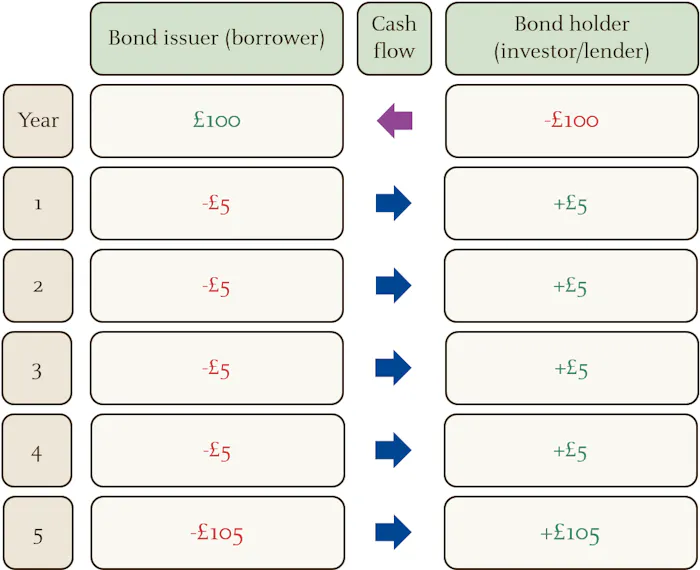
Let’s imagine an investor pays £100 for a bond that pays 5% (the coupon) per year, and matures in five years (the maturity date).
The investor in this example lends £100 at the start of year one. At the end of each year the investor receives £5. At the end of the fifth year, the investor receives their initial £100 in addition to their final annual interest payment.
Illustrating how a bond with a five-year maturity might work
Source: J.P. Morgan Personal Investing, for illustration purposes only
Par value (also called face value) is the principal amount a bond issuer promises to repay the bondholder at maturity. Par value is usually set at a standard amount, such as £100 per bond, and it forms the basis for calculating interest payments.
Interest payments are also referred to as 'coupon' payments, dating back to an era in which bonds were paper certificates with coupons attached that were physically exchanged for cash.
In the example above, the coupon rate is 5%, because the payments are of £5, and the par value is £100.
Par value is not the same as the bond’s market price, which can rise above par (a premium) or fall below par (a discount) after it is issued. In the secondary market, bond prices move in response to a range of influences.
What an investor pays for a bond impacts the bond’s rate of investment return, or the ‘bond yield'.
What is bond yield?
Yield is a way of expressing a bond’s return as an annualised percentage, so that bonds can be compared more easily. There are different ways to calculate yield, and understanding what these mean can be valuable to investors.
Yield is a vital concept for bond investing. Here we explain how bond prices, coupons and yields connect.
The coupon rate is the interest rate applied to the bond’s par value. If a bond has a par value of £100 and a 5% coupon, it will pay £5 per year.
Current yield is a simple form of yield that reflects the market price.
- If the bond price is £100, current yield is £5 ÷ £100 = 5.0%
- If the bond price is £95, current yield is £5 ÷ £95 = 5.3%
- If the bond price is £105, current yield is £5 ÷ £105 = 4.8%
Current yield is a helpful snapshot, but ignores two important details. It does not factor the difference between price paid and amount repaid at maturity (in this example, £100). This change is often called ‘pull to par’. Current yield also overlooks any return you may earn from reinvesting coupon payments.
Yield to maturity (YTM) is a single annualised rate that estimates the total return if you hold the bond to maturity, the issuer pays all cash flows as promised (and assuming that it doesn’t default), and coupon payments are reinvested at – or close to – that yield. If you can only reinvest coupons at a lower rate, your total return may be lower (this is called 'reinvestment risk').
YTM does reflect the ‘pull to par’ effect:
- If you buy below par (e.g., £98) and get £100 back at maturity, that adds to return. If you paid £98 for the example £100 bond above, the YTM would be 5.45%.
- If you buy above par (e.g., £103) and only get £100 back at maturity, that reduces return. If you paid £103 for the example £100 bond above, the YTM would be 4.33%.
Bond prices move in response to developments in the world around us, but particularly interest rates, inflation expectations, and any change in the issuer’s perceived credit-worthiness.
If investors demand a higher return (higher yield) for holding a bond, its price generally has to fall. If investors accept a lower return (lower yield), the price can rise. As a result, yields move in the opposite direction to bond prices.
Types of bonds
Gaining an understanding of the key types of bonds can help investors integrate them into a portfolio. Different bonds are exposed to different risks, and can perform slightly different functions in a portfolio accordingly. ‘Fixed income' is often used as an umbrella term for bonds and other interest-paying investments.
For individuals and smaller companies, a conventional loan from a bank may fulfil a need for extra capital. Governments and larger companies are more likely to need the scale and liquidity of global bond markets when raising capital, where they can access many potential lenders at once.
Government vs corporate bonds
Government bonds
Governments can issue bonds as part of their capital and overall cash management. If the government runs a deficit (spending more than it receives in tax revenue) it will need to issue more bonds compared to running a balanced budget (or a surplus). Government bonds go by a few different names depending on the country issuing them. In the UK, government bonds are often called 'gilts', harking back to a time during which these bonds were physical documents with gilded edges. US government bonds are typically referred to as Treasuries. Investors may also hear the more general term 'sovereign bonds'.
Corporate bonds
A company may issue a bond to raise money to fund a variety of activities related to company operations and growth. Bonds issued by companies are called corporate bonds. Companies can also raise capital by issuing equity, but this usually means adding new shareholders, which can dilute the company ownership. When using bonds to raise capital, company ownership is not altered. Additionally, while bondholders are typically promised contractual interest and principal repayment, dividends on equity are generally discretionary. Equity also has no maturity (the investor usually needs to sell their shares in the market).
There are benefits and drawbacks to both equity and debt financing, so companies usually use a balance of the two in what is called their ‘capital structure' (See also 'capital stack' below).
Bonds that pay the investor a set number of interest payments, at a set rate, over a set term, before the initial sum invested is returned on a set date are often called 'plain vanilla' bonds. For most investors, bond investments will typically be in vanilla government and/or corporate bonds. Floating rate (securities whose interest payments can go up or down as market rates change), inflation-linked and other bond structures also exist.
Inflation-linked bonds link payments and/or an investor’s principal to an inflation index, which can help protect purchasing power (prices can still rise and fall and returns depend on the price you pay). Investors can receive higher cash flows when inflation rises. In the UK, these are generally ‘index-linked gilts', and issued by the government.
Zero-coupon bonds pay no periodic interest, but are issued at a discount and repay a single amount (face value) at maturity. Zero-coupon bonds are very sensitive to interest rate changes.
How are bonds rated?
Bonds can be further categorised based on credit rating. Credit ratings are produced by rating agencies to give investors an opinion on how stable a bond issuer (or individual bond), is assessed to be, and therefore how likely the agency believes it is that the bond’s terms will be honoured. In some instances a bond’s credit rating can differ from that of the issuer, based on factors such as collateralisation, seniority or guarantees.
There are three major credit rating agencies: Moody’s, S&P Global (Standard & Poor’s) and Fitch. All three use broadly similar ‘investment grade' vs 'high-yield' categories, but their rating symbols aren’t identical. S&P Global and Fitch use letter grades such as AAA down to D, while Moody’s uses a different scale from Aaa down to C.
Credit ratings apply to both government bonds and corporate bonds.
As a rough guide of what they mean:
- AAA (or the Moody’s equivalent, throughout): Highest credit quality; very strong capacity to meet obligations.
- AA+, AA, AA-: Very high quality; strong capacity, only slightly more sensitive to adverse conditions than AAA.
- A+, A, A-: Strong capacity to pay; more exposed to economic or business changes than AA.
- BBB+, BBB, BBB-: Adequate capacity to pay; lowest rung of 'investment grade' and more vulnerable to downturns.
- C / CCC: Very high credit risk. The issuer is likely already in serious financial distress. Repayment depends on favourable conditions or a restructuring. Often viewed as 'near default'.
- D: Default. The issuer has failed to make scheduled payments (or has entered bankruptcy / a distressed debt exchange), meaning obligations are not being met as agreed.
Broad category | S&P credit rating (guide) | Fitch credit rating (guide) | Moody's credit rating (guide) | Characteristics |
|---|---|---|---|---|
Investment grade | AAA, AA+, AA, AA-, A+, A, A-, BBB+, BBB, BBB- | AAA, AA+, AA, AA-, A+, A, A-, BBB+, BBB, BBB- | Aaa, Aa1, Aa2, Aa3, A1, A2, A3, Baa1, Baa2, Baa3 | Higher-quality issuers with lower default risk – typically offering steadier income, but usually lower yields. |
High-yield (speculative) | BB+, BB, BB-, B+, B, B-, CCC+, CCC, CCC-, CC, C | BB+, BB, BB-, B+, B, B-, CCC+, CCC, CCC-, CC, C | Ba1, Ba2, Ba3, B1, B2, B3, Caa1, Caa2, Caa3, Ca, C | Lower-rated issuers offering higher yields to compensate for higher default risk – often with bigger price swings, especially in weaker economic periods. |
Default / failure | D | RD, D | Often shown as C (lowest) | The issuer has missed payments – these bonds can trade at deep discounts. Outcomes can depend on restructuring and/or recovery of assets, with a high risk of losing capital. |
Source: J.P. Morgan Personal Investing July 2026, S&P, Fitch, Moody’s
Investment grade bonds
Investment grade bonds are rated as having relatively low risk of default. These bonds carry ratings from AAA, down to BBB- from S&P and Fitch. Moody’s investment grade credit ratings go from its highest rating of Aaa, down to Baa3.
Investment grade bonds usually have lower yields than riskier bonds because default risk – the risk that the issuer fails to pay some or all of the money it has borrowed – is deemed to be lower. Many institutions can only hold investment grade due to policy or regulation.
High-yield bonds
High-yield bonds have lower credit ratings below investment grade, (i.e. BB+/Ba1 and lower). High-yield bonds often pay higher interest rates to compensate investors for higher default risk and greater price volatility. High-yield performance is often more sensitive to the economic cycle and company fundamentals than to small interest-rate changes.
The role of bonds in a portfolio
Steady income
Bonds can be especially valuable for people investing for income, due to the cash flows often received while held. Equity investments can provide investors with income via dividends, and many equities have paid dividends consistently for years. Even so, in most cases, dividends paid to equity holders are 'discretionary', meaning that company management can increase, decrease or stop dividends – either temporarily or permanently – if they believe the capital can be better used for running the company, or profits are not strong enough to justify a dividend.
Bonds offer investors the ability to factor cash flows into financial plans more dependably, so they can be valuable in achieving known life goals investors are working towards.
Capital preservation
Government bonds, particularly government bonds issued by economically stable developed nations such as the US and the UK, are traditionally considered to be low-risk investments. This does not mean they carry no risk, and we will explore the risks involved in bond investing later in this guide. However, high-quality sovereign bonds are generally viewed as having lower default risk, especially when issued in the government’s own currency. Sovereign default or restructuring is less common for top-rated issuers, but not impossible. Gilts and Treasuries are often used by investors seeking to prioritise capital preservation, and are typically among the most liquid assets in bond markets.
Corporate bonds rank above equity in what is referred to as the ‘capital stack'. The capital stack refers to the hierarchy of claims over a company’s assets and cash flows. This means that if a company were to go into administration and its assets liquidated, the most senior bondholders would typically recover their invested capital from asset sales first.
The seniority of corporate bonds can vary. A company may, for example, issue both 'senior secured’ and 'senior unsecured’ debt (among others). The former will typically be collateralised against specific assets, while the latter will not. In the case of company failure, the senior secured bondholders would generally receive money back from the sale of the assets used as collateral. The unsecured bondholders would receive proceeds of assets liquidated thereafter (scenario dependent), and so on. Equity holders, if they receive anything at all, would usually only do so after all other investors.
Diversification
Bonds can be valuable in improving portfolio diversification. Bonds are typically less volatile than equities, meaning bond prices are generally less variable than equity prices. Additionally, bonds and equities have historically moved differently. Since the early 2000s bonds and equities have been largely ‘inversely correlated' (prices move in opposite directions) but over the very long term they have exhibited some positive correlation (prices move together). The aim of portfolio diversification is to find assets with low to no correlation in returns.
Asset class risk-return trade-off
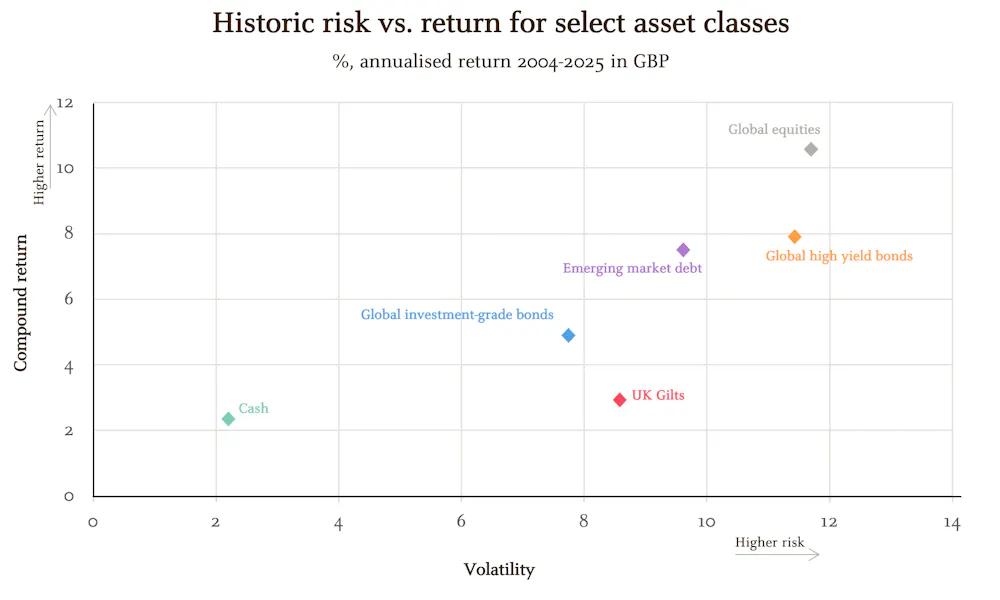
Source: Bloomberg, LSEG Datastream, MSCI, J.P. Morgan Asset Management. Volatility is the standard deviation of annual returns since 2004. Cash: J.P. Morgan Cash United Kingdom (3M); UK Gilts: Bloomberg Sterling Gilts; Global investment-grade bonds: Bloomberg Global Aggregate – Corporate; Emerging market debt: J.P. Morgan EMBI Global Diversified; Global high yield bonds: ICE BofA Global High Yield; Global equities: MSCI All-Country World Index (includes developed and emerging markets). Past performance is not a reliable indicator of current and future results. Guide to the Markets – UK.
Data as of 31 December 2025. Annualised returns reflect the average return of an asset class expressed as a yearly rate. Guide to the Markets - UK.LV–JPM57517 | 01/26 | UK | 682c09e0-5585-11eb-9ed0-eeee0affa179
Lifestyling
'Lifestyling' is a goals-based approach to investing. As you get closer to the point you’ll need your money – such as retirement, a house deposit, or paying school fees – you may gradually reduce how much risk you’re taking, with the aim of reducing the variation in your portfolio’s value.
In practice, that often means increasing exposure to assets that have historically been less volatile than equities, such as high-quality bonds such as UK government gilts or investment grade corporate bonds. The aim isn’t to maximise returns at all costs but to reduce the risk of a sharp equity market fall arriving at exactly the wrong time, when you’re about to start using your investments.
There’s no single 'right' glidepath for everyone. The best mix depends on your time horizon, income needs, and how comfortable you are with portfolio ups and downs. Bonds are often a central building block for managing risk as financial goals get closer.
Understanding risks in bond investing
Bonds can be comparatively stable investments relative to equities, but can be sensitive to certain factors investors should understand. When buying a bond, investors often think of it as buying a series of cash flows, which can help understand how prices move.
Several important elements of bond pricing and risks are outlined below.
Default risk
Default (credit) risk is the risk that a bond issuer fails to make a payment as promised. Default can mean failing to pay a coupon, or failing to repay the bond’s principal at maturity (or both). If an issuer’s financial position deteriorates, the bond’s price can fall, and investors selling their bond may do so at a loss. If the company faces insolvency investors may also recover only part of their investment. In some cases, investors can lose most or all of their investment, with outcomes depending on factors such as the issuer’s assets, the bond’s seniority in the capital structure, and any restructuring process.
Duration risk – How interest rates affect bonds
Duration is an important concept in bond investing. When interest rates change, bond prices usually move in the opposite direction. Duration estimates how sensitive a bond is to those changes.
The higher a bond’s duration, the more sensitive it is to changes in rates. As a rough illustration, if Bond A has a duration of five years, then a rise in yields of 1% could reduce the price of Bond A by about 5%. If the same bond had a duration of three years, and yields were to rise by 1%, the bond’s price would theoretically fall by roughly 3%, and so on. Actual price sensitivity might differ, but this can be a helpful guide.
Longer-maturity bonds are often more sensitive to rate changes because more of their value comes from cash flows further in the future, which are more affected when discount rates change. A discount rate is the interest rate (or required return) used to convert future cash flows into their value today – higher discount rates make future cash flows worth less in present-value terms. The further into the future the cash flow is, the more impacted it will be – in present value terms – by the discount rate.
You may see duration expressed in a few different ways in investment product information. Most investors don’t need a lot of detail on duration and how it is calculated. However, it is important to understand the core concept. Bonds can be sensitive to changes (or expected changes) in interest rates.
Credit spread
Credit spread refers to the difference between the yield on a corporate bond and a comparable government bond.
Governments generally receive taxes, and as residents are legally obliged to pay them, this provides a predictable source of income for governments from which they can pay bond payments. Additionally, while governments will generally be mindful not to erode market trust in the value of their currency and bonds, theoretically they can also print money to cover bond payments. Companies do not have this luxury. Companies typically need to make enough money through sales to cover their expenses, which includes the risk they are unable to cover interest payments on bonds the company has issued. To compensate for this higher risk, investors typically require a higher return on corporate bonds than government bonds.
This is the credit spread. For example, an investor in a UK company’s five-year corporate bond would typically demand a higher return than they would for a five-year UK government bond.
Credit spread differs depending on many factors. The credit rating of a bond can be important to its credit spread. As outlined above, some bond issuers have stronger credit ratings than others. Bonds issued by companies with weaker credit ratings (e.g. high-yield bonds) will usually have higher credit spreads than bonds from companies with strong credit ratings (e.g. investment grade bonds). Credit spreads can also widen and narrow depending on factors such as overall investor risk appetite, level of bond issuance and macroeconomic conditions. A rating downgrade could for example, reduce the potential pool of investors for that bond. Some investors cannot hold high-yield bonds, and if it becomes harder to find buyers for a bond, this can mean the credit spread widens.
Government bond returns are often driven more by interest rates, while corporate bond returns reflect both interest rates and changes in credit spreads. Interest rate sensitivity depends mainly on a bond’s maturity and coupon (its duration).
Inflation and inflation expectations
Earlier in the guide we described bonds as a series of cash flows. Because bonds promise fixed payments in the future, if inflation rises, each bond payment you receive in the future is worth less. If investors expect higher inflation, bond yields will generally rise to make up for the loss of buying power.
Interest rates are one tool used by central banks to control inflation, so the two are closely linked. Bond investors will generally keep track of inflation and any reasons it may rise or fall. In addition, investors will often make a call on how effective a central bank is deemed to be in keeping inflation under control.
Currency risk
If an investor buys a bond issued in a foreign currency, this can influence bond returns. For example, a UK investor holding a US-dollar bond may lose money in pound terms, if the dollar falls versus the pound. Currency moves can sometimes outweigh the bond’s yield. Some funds use currency hedging to reduce this risk. Currency hedging refers to the management of currency exposure, or currency risk, associated with owning foreign assets.
Liquidity risk
Liquidity refers to market depth and trading volume (or how easy an investment is to buy and sell). Bonds can be more illiquid than other asset classes and are predominantly traded off-exchange (over the counter). With less actively traded bonds, you may need to accept a lower price (or wait longer) to find a buyer.
How to invest in bonds – Putting it into practice
Bonds can add a steady, more predictable source of income to a portfolio, and can improve portfolio diversification by behaving differently to equities.
Government bonds from issuers like the UK and US government can be especially beneficial for investors with a capital preservation priority, especially if they understand how longer duration assets can be more sensitive to interest rate changes. Corporate bonds can add a valuable boost to income, for investors mindful that they typically carry more credit risk.
Buying individual bonds
It’s feasible for UK retail investors to buy individual bonds, but it’s often less straightforward than using collective investments like bond funds or ETFs.
UK gilts are generally the most accessible route for investors that want to buy individual bonds. Some investment platforms let you buy gilts in the secondary market (where investors buy and sell existing bonds to each other after they’ve been issued), but managing the bonds yourself can add complexity. UK corporate bonds are also feasible, but access varies by platform. Liquidity can be lower, so it can be harder to sell quickly at a price close to what the investor expects, and investors would face more issuer‑specific credit risk. Bond issues will often have high minimum holdings (sometimes £10,000 or more) often making it undesirable to hold in portfolios due to concentration and liquidity.
Costs and complexity matter: with individual bonds you need to manage maturity dates, reinvestment (rolling cash into new bonds), ongoing credit monitoring (tracking issuers’ financial health and risk), and call features (bonds that issuers can repay early). Dealing costs and spreads can be more significant than they look at first glance.
Using collectives to buy bonds
If you can’t (or don’t want to) buy individual bonds, ‘collective investments' are a common way to add bond exposure.
OEICs and ETFs let you buy a diversified basket of gilts and/or corporate bonds in one holding, improving diversification and liquidity, while ongoing maintenance is handled by the fund’s management/administration. A common approach is to pick a single 'core' bond fund – for example, a broad UK gilt fund – and size it to the role you want bonds to play. Investment trusts (ITs) can also provide bond exposure, but because they trade like shares, their price can move to a premium or discount. This means an investment trust’s share price can trade above (at a premium) or below (at a discount) to the value of its underlying assets per share. Some ITs also use gearing (borrowing to invest more, which can amplify gains and losses). As a result, accessing bonds via ITs may mean the bond allocation is not as straightforward, so it’s worth being clear on the vehicle you choose.
Risk warning
As with all investing, your capital is at risk. The value of your portfolio can go down or up and you may get back less than you invest.
Past performance and forecasts are not a reliable indicator of future performance. We do not provide investment advice in this guide. Always do your own research.