Younger investors are more bullish than older generations for 2026
5 min

Younger investors are more optimistic about securing positive returns this year than those in the Gen X category (aged 44-59). But many Gen Z (aged 18-27) and millennials (aged 28-43) are getting investment ideas from financial influencers, social media and online forums, which could put them at risk.
At a glance
- Younger people are more bullish than older investors and are formulating plans to invest more than they typically do this year, according to our research¹
- Many young investors are looking to social media, financial influencers and online forums for investment ideas
- UK retail investors are more confident about the prospect of positive investment returns in 2026 than last year.
A survey of 1,000 UK retail investors, commissioned by J.P. Morgan Personal Investing, reveals a general rise in investor confidence for the coming year.
Two-thirds of those surveyed are confident about the prospect of positive investment returns in 2026, compared with 58% of those who responded to the same question last year. The general appetite for investment risk has also increased since 2025, with 44% of respondents to our latest survey saying that they had appetite for a medium level of risk, compared with 38% last year.
Our survey shows that confidence is highest among younger investors
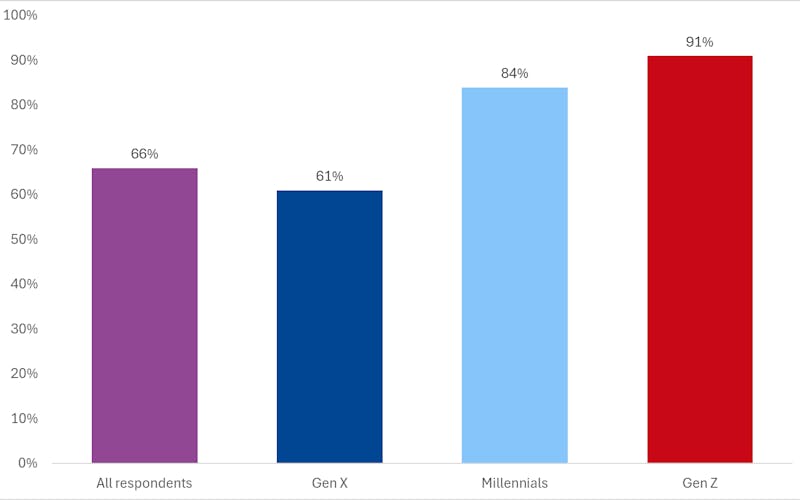
Source: J.P. Morgan Personal Investing survey of 1,000 UK retail investors. Chart measures net confidence of UK retail investors about the prospects for positive investment returns in 2026.
Confidence is highest among younger investors. Gen Z investors were the most upbeat about markets in our survey, followed by millennials. The majority of Gen X investors were also optimistic.
Young people are making plans to invest more this year than they typically do, with 44% of Gen Z and 45% of millennial respondents to our survey saying that they intended to increase how much they invest.
Gen Z are optimistic about the global economy
Of those who told our survey that they planned to invest more in 2026, 47% of Gen Z said this intention was motivated by their optimism in the global economy, while a desire to build wealth for the long term was common across Gen Z, millennials and Gen X.
Receiving passive income from dividends also appealed to Gen Z and Gen X investors more than it did for millennials, while Gen Z in particular want to invest more in the artificial intelligence boom.
Regardless of generation, building long-term wealth is the most popular reason for wanting to invest
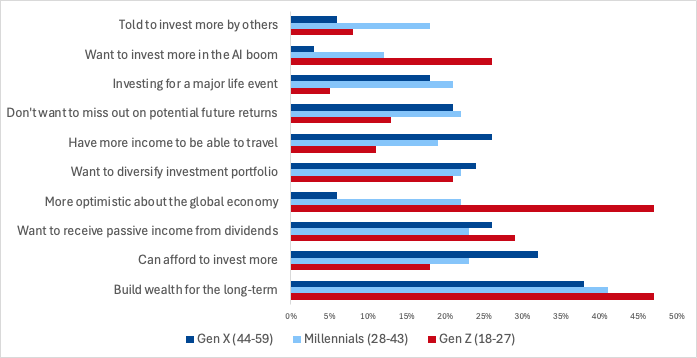
Source: J.P. Morgan Personal Investing survey of 1,000 UK retail investors. Chart measures rationale for wanting to invest more in 2026.
Younger investors look to social media, forums and ‘finfluencers’
It’s encouraging to see enthusiasm among younger people for investing. While many Gen Z and millennial investors source their ideas from more traditional providers of information, such as newspapers, financial advisers or investment providers, a significant proportion of those who responded to our survey now get tips from social media, online forums like Reddit, and financial influencers, also known as ‘finfluencers’.
Gen Z tap a range of sources for investment ideas, while Gen X rely on more traditional channels
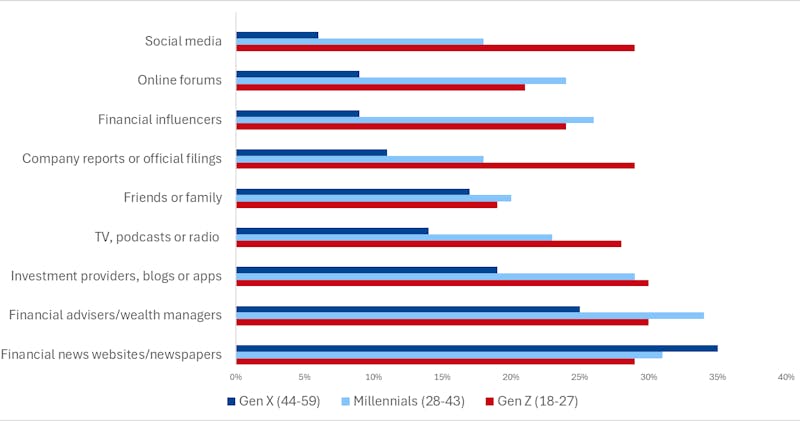
Source: J.P. Morgan Personal Investing survey of 1,000 UK retail investors. Chart measures typical sources of investment tips or ideas.
It’s perhaps unsurprising to see younger investors gravitate towards the internet for support when they invest. But while there are some useful sources of information that can help you understand financial concepts, investing based on information gleaned from social media, forums or finfluencers can lead to investors making bad decisions or even being scammed.
Regulators are acting against misleading information and finfluencers. The Financial Conduct Authority has taken action which has led to arrests and forced the removal of misleading content on social media as part of a crackdown on “rogue finfluencers”.
These sources of investment ideas may well be translating into the types of investments that younger people are opting for. Crypto assets (such as Bitcoin), as well as gold, feature heavily among the investment plans of younger investors for 2026, as shown by the below chart. These assets, which can be volatile and high-risk, are regularly tipped online.
Crypto and gold are the asset classes most under consideration by younger investors
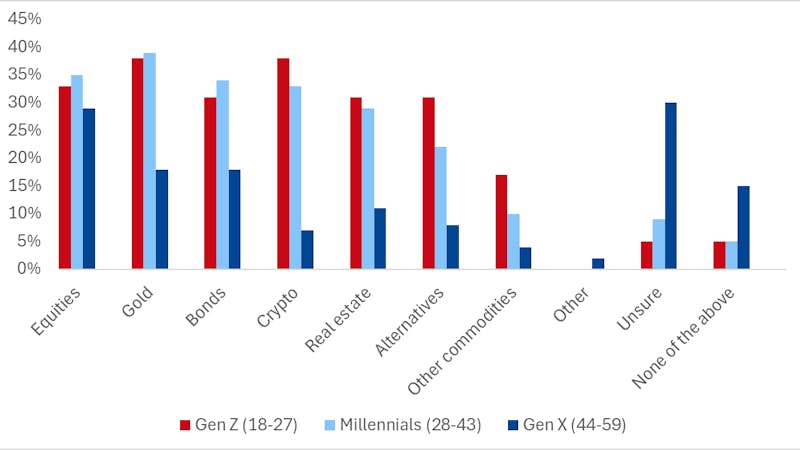
Source: J.P. Morgan Personal Investing survey of 1,000 UK retail investors. Chart measures asset classes under consideration by investors in 2026.
“There are plenty of well-intentioned people online who want to help young investors build wealth,” says Claire Exley, Head of Financial Advice and Guidance at J.P. Morgan Personal Investing. “Engaging with online sources can be a useful way of building your background knowledge, but always make sure that you’re getting your information from a reputable source, and consider obtaining financial guidance or advice before making any decisions.”
We provide free financial guidance, where we can work with you to explore your options, answer questions and get to understand your risk appetite, including which investment style could be right for you.
We also offer paid financial advice where we get to know you and build a personalised financial plan for you to follow based on analysis of your income, savings, and spending habits. You will pay a one-off fixed fee and you can book a free consultation first to see if it's right for you. It is called 'restricted' advice, because the plans and solutions we build for our clients are based on our own products and services, not those available outside of J.P. Morgan Personal Investing.
Risk warning
As with all investing, your capital is at risk. The value of your portfolio can go down or up and you may get back less than you invest. We provide 'restricted advice', meaning we only make investment recommendations on the products and services that we offer.
1 Opinium survey of 1,000 UK investors undertaken on the 3rd to 10th December 2025. Year-on-year data is compared with a survey undertaken by Opinium at the start of 2025 (9th to 16th January 2025) using the same panel of 1,000 UK investors. Opinium Research is a member of the British Polling Council and abides by its rules.