IPOs: what are they? And why do they matter for investors?
9 min

SpaceX’s recent initial public offering (IPO) was the largest ever, while IPOs could be around the corner for artificial intelligence (AI) giants OpenAI and Anthropic. But what is an IPO? And can your portfolio have exposure? This article answers why they matter for investors.
What is an IPO?
An initial public offering (IPO) is the process through which a company offers investors the opportunity to purchase its shares on a public market for the first time. This is typically followed by the company ‘listing’ on a stock exchange, where investors are then free to trade the stock. This shifts the company from being privately owned to publicly traded.
A company looking to conduct an IPO will sell a combination of new shares (to raise fresh capital) and existing shares (to provide an opportunity for existing investors to sell). When a company sells newly-issued shares in an IPO, investors are buying in the ‘primary market’, so the proceeds go to the company. Once those shares are listed and trading begins, investors who buy or sell generally do so in the 'secondary market'.
These secondary-market purchases do not give an investor exposure to the IPO itself, but it is a way to invest in a newly listed company.
Why do IPOs matter for investors?
The public markets, and the companies that comprise them, are dynamic.
Some companies grow to become market leaders, some jostle for position in the middle of the pack, while others can become acquisition targets or be subject to bids to take them back into private ownership.
This has consequences for stock market indices, as they reflect the performance of certain groups of companies, such as technology-related firms. The constantly evolving picture of each company’s health and position in the market means that the mix of firms in each stock market index evolves over time. From quarter to quarter, this won’t change much, but over longer periods, changes can be stark.
If we look at the Nasdaq 100 index – which reflects the performance of around 100 of the largest non-financial firms listed on the Nasdaq stock exchange – 18 of the current constituent companies have completed an IPO in the last 10 years. This includes household names such as AirBnB. This shows how much an index can change, and how IPOs bring companies within easy reach of investors in the public markets.
Scott Gardner, Investment Strategist, notes that “going through an IPO is not a measure of future success in itself, but it is a prerequisite to becoming a major constituent of different publicly traded indices.”
Can retail investors access IPOs?
This is dependent on a variety of factors, including:
- Whether the IPO strategy includes marketing to the retail investment market
- Minimum investment sizing may be substantial
- Level of sophistication of the retail investor
- Location of the retail investor – availability is sometimes restricted depending on location
- Brokers’ access to the deal typically depends on who the firm places the offering with
Depending on the IPO, it may be possible for retail investors to gain access via specific brokerage platforms, but eligibility criteria can vary.
Often, with an IPO that is in high demand, large, sophisticated institutional investors can account for much of the investor base. Institutional investors will typically take large blocks of shares, which can come with efficiencies.
However, the retail market is vast, and some offerings may look to harness the power of retail investors as part of their strategy, albeit that can come with challenges such as retail's more fragmented nature.
Managed portfolios at J.P. Morgan Personal Investing do not invest in IPOs, but the portfolios may gain exposure to the subsequent listed shares through the ETFs we invest in. This is dependent on the market and index, amongst other factors, and we go into this in more detail later.
What do IPOs mean for indices?
Index providers, such as S&P Dow Jones, have specific rules for companies to be included in their indices. To be included in the S&P 500 – which reflects the performance of 500 of the leading US listed companies – an entrant must (amongst other factors) be profitable under Generally Accepted Accounting Principles (GAAP) in its most recent quarter as well as for the sum of its most recent four quarters.
However, other index providers have recently adjusted their rules for admission, helping to form a fast-track pathway for companies to enter the public markets.
In reference to the SpaceX IPO in June, Scott Gardner noted in the run up that Nasdaq tweaked its rules for inclusion moving forward “to ‘win’ the listing”. He explained that SpaceX would be included within 15 trading days if it was in the top 40 index members by market capitalisation.
Now we are over a month on from the IPO and the dust has begun to settle, SpaceX’s market capitalisation sits around the $1.7 trillion mark, as of 16 July. This places it in the top 10 companies in the index by that metric, fulfilling the criteria to be added to the Nasdaq 100 index.
What do IPOs mean for index fund investors?
Index-tracking ETFs – which we use alongside other ETFs in our managed portfolios – give investors exposure to an index's underlying constituents, typically weighted by market capitalisation.
However, due to technical factors such as the number of available shares that can be traded (the free float), a new entrant such as SpaceX will not immediately be represented in this proportional way. As such, exposure through index funds will be much smaller than it is for other similarly sized peers, for the time being at least. Over time, this should increase as holding restrictions ease, but due to different rules between index providers, timing and allocation size will vary. Investors should do their research if they want to have exposure, or not, to these names.
Can you avoid exposure to these companies in managed portfolios?
It depends on how you invest. We do not take stock-specific views within managed offerings such as our Fully Managed portfolios and instead see the value of investing sitting in asset allocation across markets, asset classes and geographies. This gives investors a well-diversified portfolio with exposure to many underlying assets.
As such, if a newly listed company becomes included in an index that we have exposure to through our portfolios' underlying ETFs, our investors may then gain some exposure. This will be dependent on investment style and portfolio risk level.
In the case of SpaceX, in our highest risk profile Fully Managed offering, around 0.05% of the portfolio is allocated to this newly listed company through ETFs, as of 17 July.
Are IPOs making a comeback?
It depends where you look. In the UK, the IPO market continues to be somewhat subdued. But looking across the pond to the US, which has the largest stock market in the world, IPOs are on the up. This is being shaped by several factors. The growth of artificial intelligence (AI) and AI-related companies is a notable driver. Some, such as OpenAI, with its well-known ChatGPT, and Anthropic of Claude fame, look set to mature from private ownership and into the public markets in the near future.
This has also coincided with interest rates falling from their 2024 peak. Lower rates impact the underlying economic dynamics of financial markets and company valuations. This can create more favourable conditions for companies to consider an IPO.
IPO value expected to continue rising
The chart below shows the annual value of US IPO activity from 2016. The value has been rising in the last couple of years and looks set for another substantial increase this year. The total is expected to be over £250 billion, close to the 2021 peak, when interest rates were close to zero. SpaceX’s June IPO, which raised $75 billion (making it the largest ever) would account for 30% of this.
For investors, this means that there are new, valuable companies entering the public markets.
Value of US IPOs in 2026 expected to be highest since 2021
Annual US IPO value, USD billions
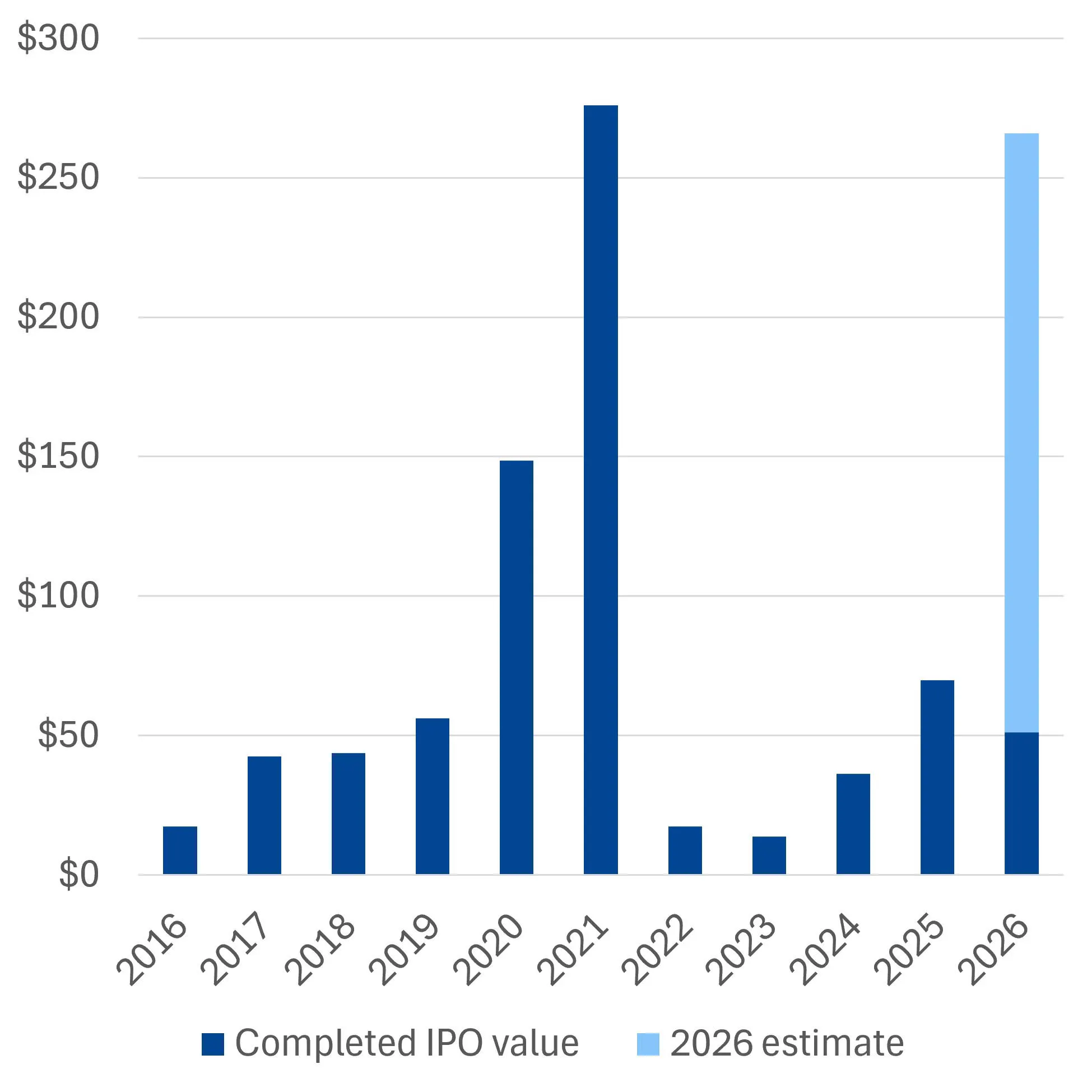
Source: J.P. Morgan Wealth Management's 'The IPO wave is historic. So is today's market'.
Authors: Kriti Gupta, J.P. Morgan Private Bank, and Abigail Yoder, J.P. Morgan Global Wealth Management. Chart original source: Dealogic, J.P. Morgan Flows & Liquidity. Data as of May 2026.
Our view
Increased IPO activity encouraging for public market investors…
We see the overall increase in IPO activity as exciting for investors. As of 17 July, we hold an ‘overweight’ position in US equities for a variety of reasons. The US, together with its many listed indices, is the global leader in public markets. It continues to be home to the most influential, profitable public companies in the world.
This makes it the leading global destination for companies to list on a stock market, including companies from the UK and Europe. This is down to the scale and influence of the US financial ecosystem, the global appeal of its indices and the firepower of local investors.
…but newly listed companies can go through a period of ‘price discovery’
It is important to note that once a company lists and shares are traded, stocks can go through a period of ‘price discovery’. Buyers and sellers feel out demand for stocks where financial indicators are lighter on the ground than for more mature peers.
Our Head of Portfolio Management, Pacome Breton, has been encouraged by the renewed momentum in the IPO market and potential upcoming listings, but highlights a note of caution and the need to remain focused on the long-term picture:
“In the short term, new listings can be extremely volatile in terms of price. There is a lot of price discovery as they go into the market and valuations can be exuberant…So I think people should be a bit cautious in the short term, but mid and long term we can really think that they are going to be very important in terms of new joiners to the market.
Breton cites a previous post-IPO example as one to keep in mind: “If we look at an example from the past, Meta (formerly Facebook) stock lost around 50% of its value in the first few months of trading but went on to gain more than 30x from that low to now*. So, a level of cautiousness can be appropriate, as even great companies can have extreme price discovery post-IPO. But it doesn't mean that they won’t be extremely visible in the next 10+ years.”
* Data from 4 September 2012 (when the stock had lost 53% of its value) to 17 July 2026.
Risk warning
The longer you stay invested, the more time your money has to grow. Investments go up and down, so at times you could get back less than you invest.
Past performance and forecasts are not a reliable indicator of future performance. We do not provide investment advice in this guide. Always do your own research.
J.P. Morgan served as a lead bookrunner for SpaceX in its recent IPO. However, J.P. Morgan Personal Investing was not involved, and we refer to the SpaceX IPO in this article only to illustrate how IPOs can affect the constitution of indices and as an example of IPO activity in the US. We are not making any recommendation in respect of SpaceX investments.