How could the Gender Pension Gap affect you?
10 min

The Gender Pension Gap can pose a problem for a lot of women in retirement, particularly those who aren't married or in civil partnerships, and/or are divorced. But there are steps that women and men can take to reduce the gap.
At a glance
- The Gender Pension Gap is partly an outcome of the Gender Pay Gap, which reduces the amount that women are able to contribute towards a pension
- Women disproportionately take on caregiving duties and are more likely to work part-time than men, which are factors that are also responsible for the Gender Pension Gap
- Having a clear financial plan can help to reduce the impact of the Gender Pension Gap. Paying into a partner’s pension is one option for narrowing disparity of retirement wealth between partners
- It can be a good idea to speak to a financial adviser to ensure that you have enough wealth in retirement, particularly in the event that you are unmarried or not in a civil partnership, and/or divorced.
What is the Gender Pension Gap?
The UK government publishes data that sets out the Gender Pension Gap in private pensions. It defines the gap as “the difference between female and male median uncrystallised private pension wealth”. In 2025, it said that in Great Britain during the period of 2020 to 2022, the gap for those aged 55-59 was 48%.
For this age group, male median private pension wealth was valued at £156,000 during this period, compared to £81,000 for women. The gap that exists for this age group is particularly important because it is when people can start accessing their private pension. Currently, people can access their private pension at the age of 55, although this threshold is rising to 57 on 6 April 2028.
The median private pension wealth of males and females, by age
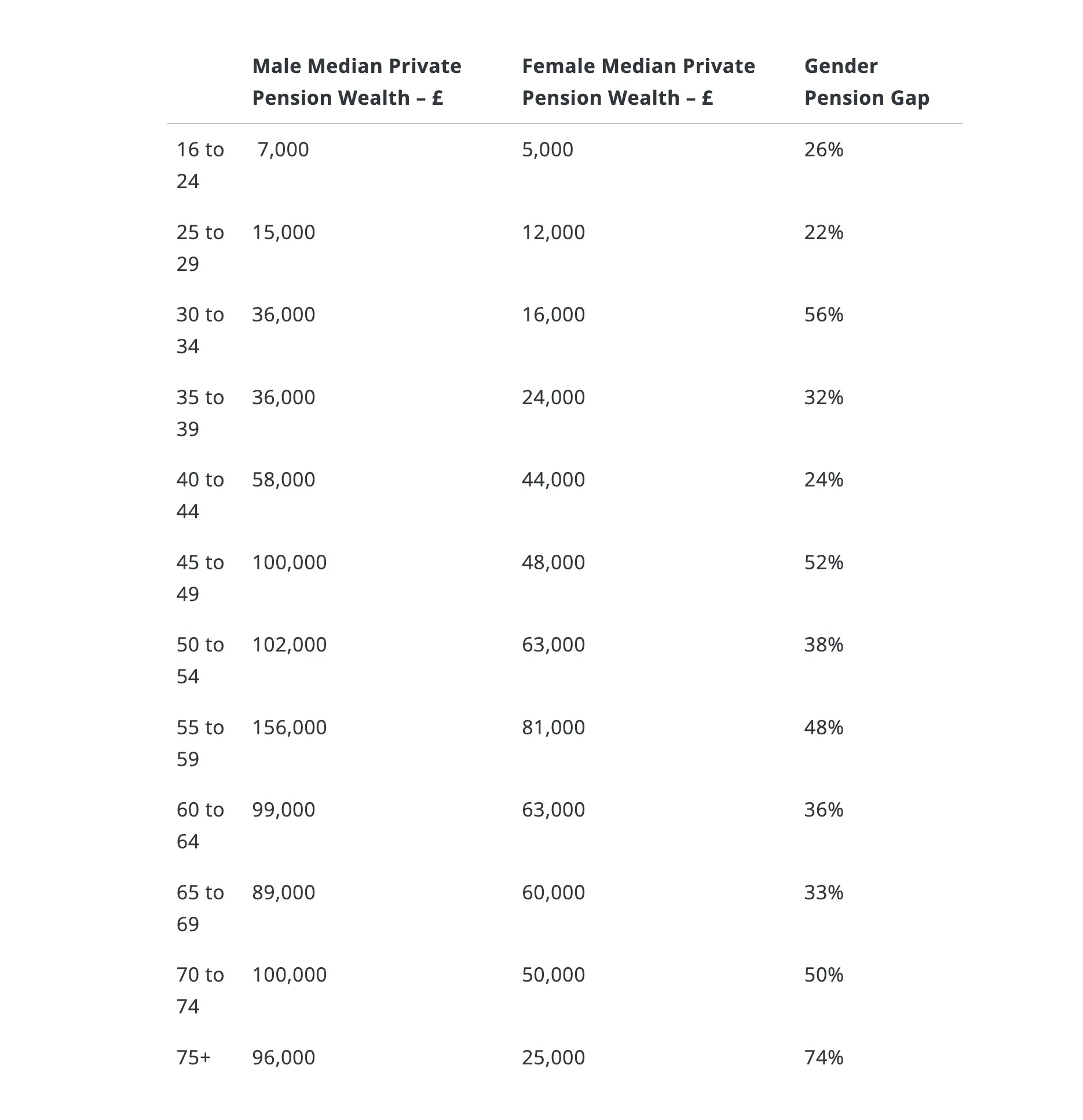
Source: The Department for Work and Pensions (DWP) estimates from Office for National Statistics Wealth and Asset Survey data, Great Britain, 2020 to 2022
Why does the Gender Pension Gap exist?
There are several reasons for the existence of the Gender Pension Gap, according to the the not-for-profit Pensions Policy Institute (PPI), which defines the Gender Pension Gap as “a measure of inequality between men and women’s pension outcomes”. This gap, the PPI says, can be represented by a difference in pension wealth built up by men and women, or a gap in the income they receive in retirement from that wealth.
The Gender Pay Gap
The Gender Pay Gap is a major cause of the Gender Pensions Gap. Women’s average annual incomes are equal to 75% of men’s incomes, per the PPI. This reduces the amount of money that women are able to contribute towards their pensions over the course of their careers.
Full-time employment vs part-time employment
Women aren’t as likely to be in employment as much as men in the UK (74% vs 83%), according to the PPI, while women in employment are more likely than men to be working part time (33% vs 9%). This can also reduce the amount of money that women are able to pay into a pension.
Working part-time can also mean that some women earn below the threshold for being automatically enrolled into a workplace pension scheme. For the 2026/27 tax year, this threshold sits at £10,000 per year, for employees aged at least 22. Employees earning between £6,240 and £10,000 can still opt into a workplace pension scheme.
Women take on a disproportionate level of caregiving
Women are much more likely to be the primary caregivers and carry out 60% more unpaid work than men, according to the PPI. The threat of expensive childcare, meanwhile, can mean that women interrupt their careers to care for children, which may impact their earnings and their ability to contribute towards a pension.
State Pension rules have penalised women
Men have historically had much higher State Pension entitlement than women, according to the PPI, with women born in the early 1940s receiving approximately 25% less in State Pension income than men on average. But changes to the State Pension have almost closed this gap, while the State Pension age was equalised at age 65 for men and women in 2018, before rising to 66 for both sexes in 2020. The State Pension age for men and women rises from 66 to 67 between April 2026 and March 2028.
Before being equalised, from 1948 to 2010 the State Pension age for women and men was 60 and 65 respectively. The PPI observes that while this difference meant that women would receive their State Pension for longer than men on average, it also meant that women who retired at State Pension age would have less time for their private pensions to accumulate wealth compared to men who retired at their respective State Pension age.
The Gender Pension Gap for the State Pension is far lower than the disparity that exists in private pensions. The gap has nearly closed for those reaching State Pension age following the move to the new State Pension in 2016, the PPI says. The difference between State Pension incomes of women and men born in the early 1950s is less than 5%, it notes.
Who is most affected by the Gender Pension Gap?
Women typically live longer than men in the UK. As of 2022-2024, life expectancy at birth in the UK is 83 for females and 79.1 for males, according to the Office for National Statistics.
Women will therefore usually need their retirement wealth to last longer when compared to men, which can be a problem given the gap between women and men in their median retirement wealth.
While a disparity in retirement wealth between women and men is arguably a problem for the whole of society, some women are more exposed to the Gender Pension Gap than others.
Women not married or in civil partnerships could pay Inheritance Tax on private pensions
While there might be disparity in a couple between the respective partners’ pension wealth, this may be less of a concern if you are in a couple, as you will typically be able to share in your partner’s pension and other sources of income.
Inheriting pensions from a deceased spouse or partner can help to ensure that the surviving partner has enough retirement wealth for the rest of their life. Having less pension wealth than your partner, therefore, may not necessarily mean having an uncomfortable retirement when your partner sadly passes, if they die before you. This principle applies irrespective of the Gender Pension Gap, but can go some way to redress the common disadvantage that women face in retirement.
At the moment, a spouse or civil partner can inherit pension wealth built up by their deceased partner without paying any tax on this wealth, although how this is paid depends on the type of pension that they had. If someone’s deceased spouse or civil partner had a defined benefit pension, then if and how they inherit any of their spouse’s money will typically depend on their scheme’s rules. They might, for example, receive a percentage of the promised pension as income, or alternatively receive a death-in-service lump sum.
A defined contribution pension, meanwhile, can be passed onto a spouse as a lump sum or converted into a steady flow of income by buying an annuity. You can buy an annuity to convert some or all of the money in your defined contribution pension into guaranteed taxable income, although J.P. Morgan Personal Investing does not offer annuities.
Currently, unused pensions are not subject to Inheritance Tax (IHT). This is set to change, however, with the government planning to bring most unused pensions and death benefits into a deceased person’s estate from 6 April 2027. IHT is paid when a person’s estate exceeds a value of £325,000 (the nil rate band) when they die. Death in service benefits will remain excluded from the estate’s value.
Those in married couples or civil partnerships, however, benefit from what is known as the ‘spousal exemption’ and do not pay IHT when they inherit assets from their partner. If you are not married or in a civil partnership, you do not benefit from this exemption and could pay IHT of 40% on any assets within your partner’s estate that exceed the nil rate band. The government plans to maintain the spousal exemption for IHT on unused pensions when the rules are updated in 2027. It should be noted that depending on the age at death, drawdowns of inherited pensions may be subject to income tax.
If you are not married or in a civil partnership, it is vital that you nominate your partner as a beneficiary with your pension provider to be sure that they will inherit your pension should you die.
Divorce can severely disadvantage women
When divorcing or ending a civil partnership, partners do not have to share or split their pensions, nor do they have an automatic right to claim some of their ex-partner’s pension. This can be problematic for women who have not been able to build up much pension wealth of their own – perhaps owing to a career break to prioritise childcare – with household finances having previously been viewed as a shared enterprise. If you are divorcing or ending a civil partnership you are, however, legally obliged to consider your pensions as part of any settlement.
Divorcing couples or those ending a civil partnership can, and arguably should, include pensions in any agreement, as they would with any other asset. You can speak to a J.P. Morgan Personal Investing wealth expert to discuss your options when divorcing. Please note that our wealth experts do not provide legal advice on divorce arrangements.
Should you pay into your partner’s pension?
One way of redressing a couple’s gap in retirement wealth is to pay towards their partner’s pension, particularly if the payer has already used up their own annual allowance. This can be an effective way to balance pension savings within a household, with the recipient still able to benefit from tax relief.
You can pay up to £2,880 per tax year towards the pension of a non-earning person, who will receive a government top up of 20% via tax relief. If the recipient is working, the amount that you can pay into their pension is capped at the annual allowance of £60,000 or 100% of their earnings per tax year, whichever is lower. Your contributions must remain below your partner’s annual pensions allowance.
You cannot pay directly into your partner’s J.P. Morgan Personal Investing Personal Pension from a bank account that does not have your partner registered as one of the named holders of the account. If you have a joint bank account with your partner, you can use this account for contributions into a Personal Pension. J.P. Morgan Personal Investing only collects pension payments via Direct Debit. You can therefore pay into your joint bank account and use this account to contribute towards the funds that we collect via your partner’s Direct Debit mandate with us. You can alternatively gift the money for them to contribute into their pension. Gifts between spouses or civil partners are not taxable.
Beyond your partner’s pension, you could explore making use of the Marriage Allowance. This allows the lower earner to transfer £1,260 of their Personal Allowance – the amount you can earn before paying tax – to their wife, husband or civil partner. This can lower the higher earner’s tax by up to £252 in a tax year, although to benefit as a couple, the lower earner must normally have an income beneath the Personal Allowance. The standard Personal Allowance is £12,570, although this falls if you earn more than £100,000.
Speak to a wealth expert
It’s important to discuss pension planning with your partner and consider any financial imbalances, such as the Gender Pension Gap, that currently exist within your relationship. You may want the support of a J.P. Morgan Personal Investing wealth expert to explore your options and help draw up a plan that works for you and your partner.
Our free guidance offering can provide support on opening a Personal Pension with us and how to contribute towards it.
Alternatively, by booking a call for our paid advice offering, a J.P. Morgan Personal Investing wealth expert can help you maximise your pension contributions ahead of tax year end and advise you on retirement planning.
Risk warning
As with all investing, your capital is at risk. The value of your portfolio can go down or up and you may get back less than you invest. Seek financial advice if you're unsure if a pension is right for you. Tax rules vary by individual status and may change. This is general information, not personalised tax advice. We provide 'restricted advice', meaning we only make investment recommendations on the products and services that we offer.