Caution over AI boom understandable, but foundations are sound
5 min

J.P. Morgan Personal Investing’s Head of Portfolio Management explains why fears of an ‘AI bubble’ may be largely overplayed, and believes the environment remains positive for risky assets.
The MSCI World – a major global equity index – reached an all-time high on 29 October, before retreating around 4.5% by 20 November. Losses from large technology stocks were slightly greater.
The decline coincided with a rise in concerns – particularly in the press – of a potential ‘AI bubble’, and questions of whether the investing theme has become ‘overhyped’ and valuations possibly too high.
Here, the investment team at J.P. Morgan Personal Investing highlight a few important points we believe investors should keep in mind in the current environment, and why fears of a bubble could be overblown.
Equities look fundamentally sound
The fundamentals of equities in general, and those of large US tech companies in particular, remain very solid. Companies in the US have just released their Q3 2025 earnings, and results have overall been very strong. The year-on-year increase in earnings has been almost 15% for the S&P 500, the best quarter since 2021.
The impact from the largest companies – the so-called ‘Magnificent 7’– remain particularly robust (the Magnificent 7 are Alphabet, Amazon, Apple, Meta Platforms, Microsoft, Nvidia, and Tesla). These companies have been highly supportive of US earnings over the last 2 years. And while quarterly earnings growth in Q3 2025 was lower than the previous few quarters, we believe this can be attributed in large part to a dip in Meta’s earnings (which we believe is a one-off), without which, the trend could have remained intact and may have strengthened.
The rest of the market in the US had a very strong earnings season, delivering double the growth expected by analysts. Overall, we see US companies as very healthy.
Equity markets don’t move in a straight line. Periods of more moderate performance after strong growth are to be expected. October was very good for markets in general, and indeed the rebound since April has been remarkably consistent. If one considers that an average year contains a 10% drawdown – the percentage difference from an investment’s peak to a subsequent trough – in equities at some point, it is hardly a surprise to see some weaker periods within a broader picture of strength.
Past performance isn’t a reliable indicator of future performance.
Narrative change from one period to another
Markets have been rattled by three main stories this year.
We have seen the narrative move from the 'end of US exceptionalism’, to fear around tariffs and more recently to the risk of an AI bubble.
We believe the risk of tariffs has receded, and the AI bubble narrative is, similarly, a relatively short-term worry.
That said, while a particularly strong earnings period for large US tech companies like the Magnificent 7 has supported recent share price strength, for non-profitable technology stocks in the US, this recent period has been extremely challenging. Many of these stocks – lacking the same fundamental strength – have risen significantly since April but sold off sharply in recent weeks, and might continue to experience difficulties.
Solactive US non-profitable technology index vs. Nasdaq 100 index
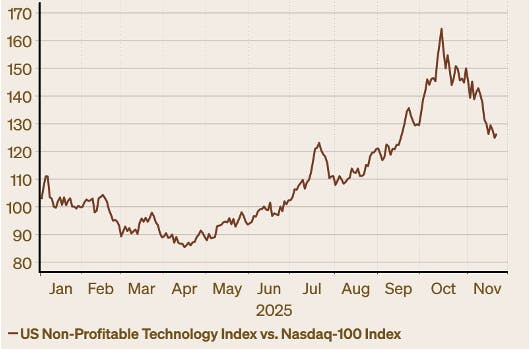
Source: Macrobond, J.P. Morgan Personal Investing, Bloomberg, November 2025. This chart shows the excess return of the Solactive US Non-Profitable technology Index vs. the Nasdaq 100 index. This chart refers to past performance, which is not a reliable indicator of future performance.
Is there really an AI bubble risk?
New technology is always extremely difficult to value. While some comparisons with the tech revolution (and bubble) of the 90s are interesting, it quickly becomes apparent the comparison isn’t really appropriate.
Whereas early internet firms built first, and worried about making money (monetisation) later, AI is monetising as it builds.
Hyperscalers – firms that operate massive data centres to provide computing services – are already seeing returns through increased cloud demand and productivity gains in coding, advertising and enterprise tools.
The view from strategists at J.P. Morgan Private Bank is similar:
“AI leadership is creating some self-reinforcing momentum…But it’s not just hype – there’s real cash flow and heavy capital spending.”
The AI model developers have very new business models, but with 99% of the global LLM market controlled by US companies, the competitive position means revenues are growing. Meanwhile, the number of large companies adopting AI into their processes – also called ‘enterprise adoption’ – is gaining traction, supported by visible productivity and profitability gains.
Demand outpacing supply:
Any wave of heavy investment runs the risk of overbuilding. At the peak of the dot-com era, only about 7% of the fibre-optic network was being utilised, leaving vast excess capacity that took years to absorb.
Today, data centre vacancy rates are at record lows and utilisation levels hover around 80%. Demand for AI continues to far outpace supply – more data has been created in the last 3 years than in all history – and AI workloads are growing in magnitude.
Utilisation Comparison – Dot-Com vs. AI
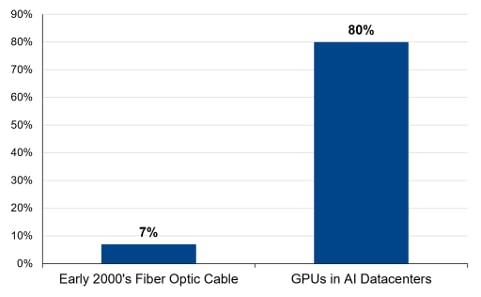
Source: J.P. Morgan Asset Management, October 2025
It's good to ask questions
We don’t think caution around AI is unwarranted. The scale of spending is enormous, the pace unprecedented and some assumptions around when these investments will pay off remain open questions. But while there will be some losers along the way, some of the large players – such as Microsoft, Amazon, and Alphabet (Google) – remain extremely well placed to reap large benefits from it.
To us, both the recent hype and caution around an AI bubble seem overplayed, and this has created some opportunities, which is often the case during periods of market nerves.
Risk warning
As with all investing, your capital is at risk. The value of your portfolio can go down as well as up and you may get back less than you invest. Past performance and forecasts are not a reliable indicator of future performance. We do not provide investment advice in this update. Always do your own research.